You know that moment in a song that's clearly happy, and then one chord sneaks in and suddenly you feel a little heartbroken? Then the song carries on like nothing happened. That chord is usually a minor iv, and it's a borrowed chord.
Borrowing chords like that is called modal interchange. The short version: you're pulling chords from a parallel mode that shares the same tonic as your key. You already know your diatonic chords, so this is just adding a few new colors to a palette you've got a handle on.
I'll keep every example in C major so you can hear the same key throughout, then transpose it wherever you need it later.
TABLE OF CONTENTS
What modal interchange actually is
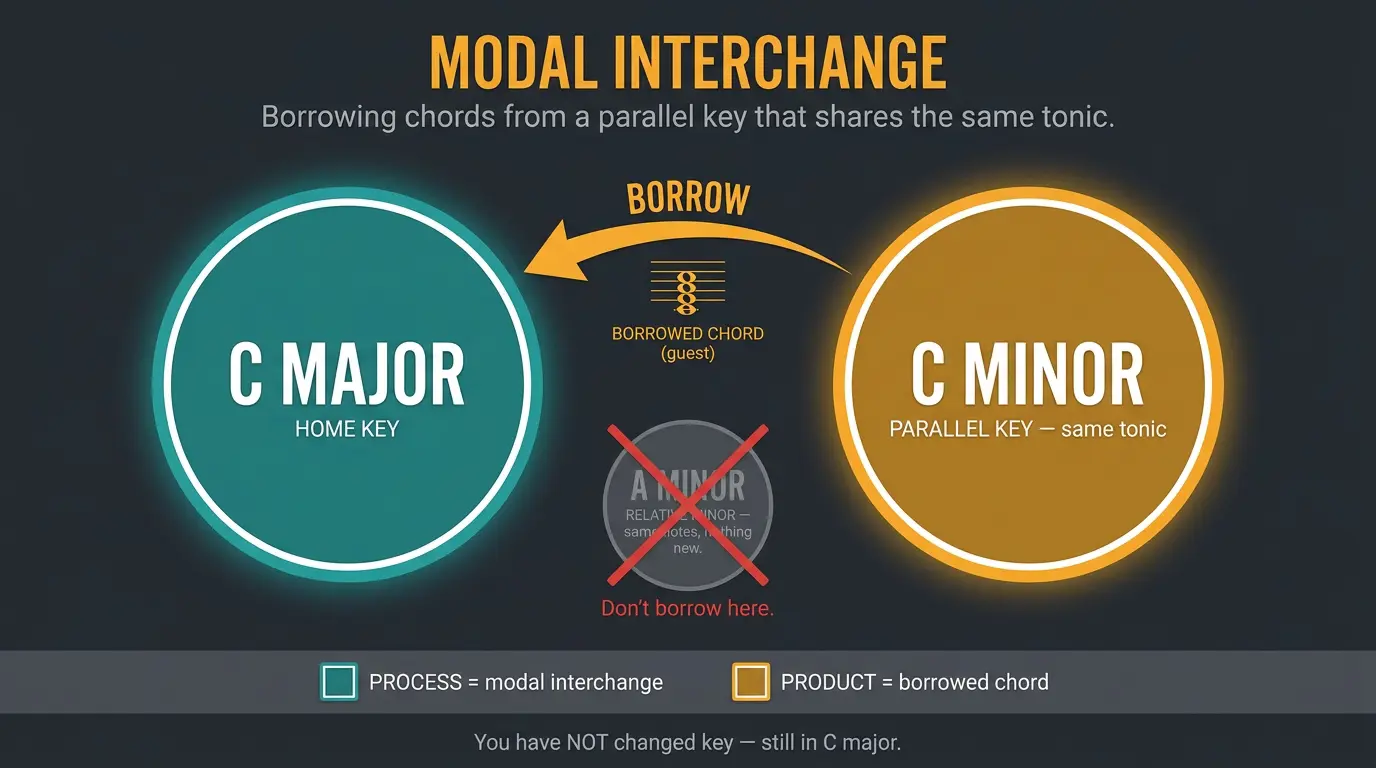
Modal interchange, also called mode mixture or just mixture, is borrowing chords from a parallel key that shares the same tonic. That's the whole idea in one sentence.
Here's the terminology worth keeping straight: modal interchange is the process, and borrowed chords are the products. When you grab a chord from a parallel mode and drop it into your progression, you did modal interchange, and the chord itself is a borrowed chord.
Now the part people trip on. Parallel, not relative. In C major, you borrow from C minor, because C minor shares the same tonic. You don't borrow from A minor. A minor is the relative minor, and it just uses the same notes rearranged, so nothing new comes from it.
And to be clear: borrowing a chord does not mean you've changed key. You're still in C major. The borrowed chord is a guest, not a new home.
How the borrowing works
Every major key gives you seven diatonic chords. Modal interchange expands that by pulling chords built from the parallel modes of the same tonic, which brings in notes your major scale doesn't have.
The most common source by far is the parallel natural minor, also called Aeolian. That's because it introduces three fresh scale degrees: the flat-3, the flat-6, and the flat-7. Those lowered notes are where most of the flavor comes from.
In theory you can borrow from any of the six other modes that share your tonic, but in practice a small handful of chords do most of the work. Let's look at those.
The borrowed-chord starter pack in C major
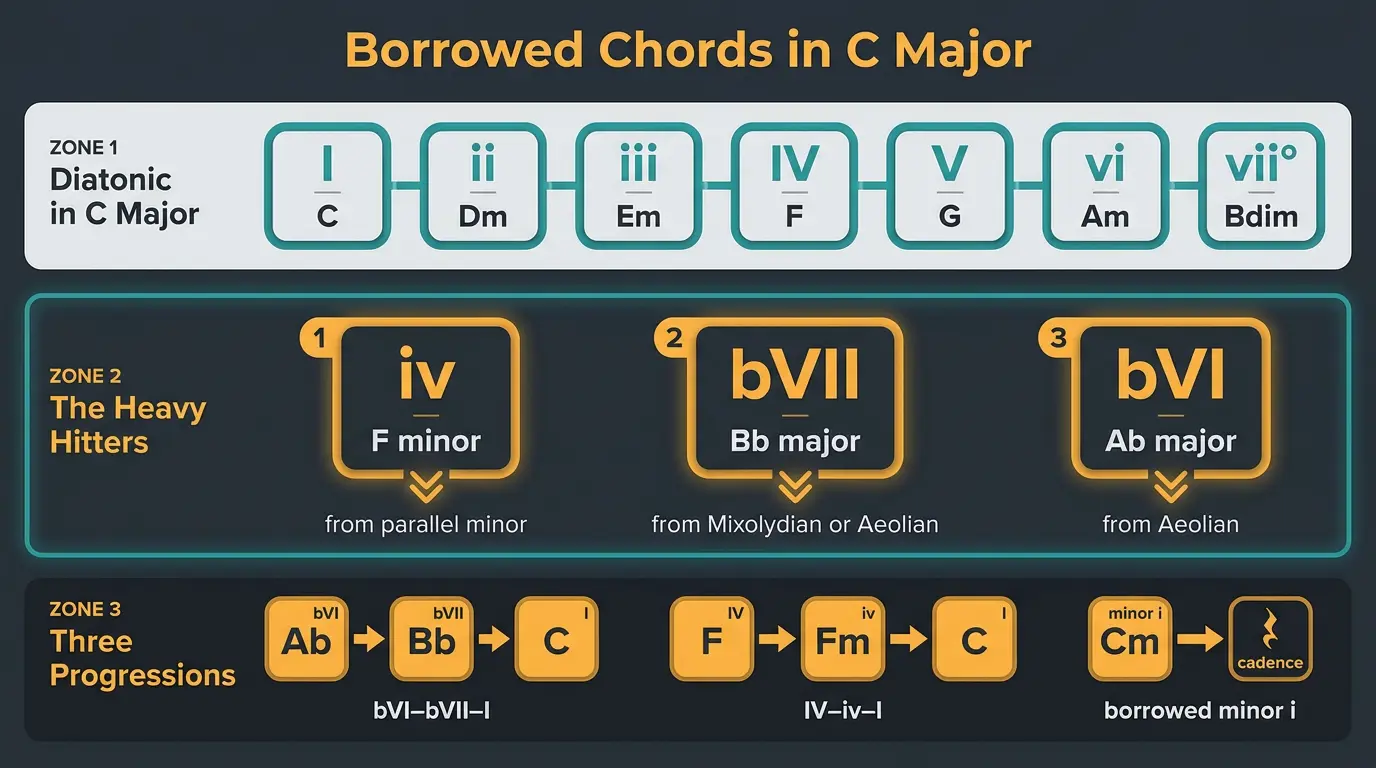
Your diatonic chords in C major are C, Dm, Em, F, G, Am, and B diminished. Everything below is borrowed on top of those.
The heavy hitters:
- F minor (iv) from the parallel minor. The most common borrowed chord in pop and rock.
- Bb major (bVII) from Mixolydian or Aeolian. Pulls hard back toward C.
- Ab major (bVI) from Aeolian. Big and cinematic, and it loves pairing with Bb.
Three progressions use these constantly. First, bVI–bVII–I, which is Ab–Bb–C. You've heard this at the end of a thousand rock songs and epic build-ups. Second, IV–iv–I, which is F–Fm–C, that bittersweet minor plagal move. Third, the borrowed minor i (Cm) landing at a cadence for a darker resolution.
Roman numerals and real chord names, side by side, so you can transpose the whole thing to any key.
| Borrowed chord | Roman numeral | Source mode | What it adds |
|---|---|---|---|
| F minor | iv | Aeolian | The classic aching swap for F major; contains Ab (b6) |
| Bb major | bVII | Mixolydian / Aeolian | Strong pull back to I; a rock staple |
| Ab major | bVI | Aeolian | Big, cinematic weight; pairs with bVII |
| Eb major | bIII | Aeolian | Chromatic mediant color, a little unexpected |
| C minor | i | Parallel minor | Darker resolution when you land on the tonic |
| Dm7b5 | iiø7 | Aeolian / Locrian | A moodier pre-dominant before G |
| Db major | bII (Neapolitan) | Phrygian | Dramatic color chord, often in first inversion |
Why these chords hit the way they do
Borrowed chords add color and a bittersweet or darker weight without leaving the key. That contrast is the point. A bright major backdrop, and then one chord that leans the other way.
The lowered scale degrees do the emotional lifting. The b3, b6, and b7 sound melancholy set against a major key, which is why a borrowed chord can make a happy song ache for a second.
Minor iv is the workhorse here. In C major, that Fm brings in Ab, the b6, and that Ab aching down to G is one of the most poignant sounds in all of pop music. If you want to hear how minor tonalities carry that weight on their own, our breakdown of minor key chord progressions and the moods they create is a good companion.
Here's the advanced tip, and honestly the real magic: it's the voice leading. Don't just block-strum the chords. Voice them so the chromatic line is exposed, like A moving to Ab moving to G in the top or an inner voice. Hear that line and the whole thing clicks.
Misconceptions worth clearing up
A few things get muddled, so let's clean them up fast.
- Borrowed does not mean relative. You borrow from the parallel key, C minor, not the relative A minor. This is the number one mix-up.
- It's not modulation. The tonic stays put. You're coloring the existing key, not moving to a new one.
- It's not the same as a secondary dominant. Secondary dominants tonicize a chord through applied dominant function. Modal interchange borrows for color. Different tools that can happily coexist.
- bVII is ambiguous. That Bb could be borrowed from Aeolian, or the whole song might just be in Mixolydian. Trust your ear about where the tonal center actually sits.
- You can borrow into minor keys too. A major IV in a minor key, or ending a minor piece on a major tonic (the Picardy third), is the same idea running the other direction.
- Chromatic mediants overlap but aren't identical. bIII and bVI can be both, but chromatic mediants are defined by root relationship, which is a separate lens.
Try this: swap and listen
- Start with a plain diatonic progression: C – Am – F – G. Play it a couple times so your ear settles into how normal it sounds.
- Now swap the F for Fm. Same spot, just minor. Listen for that Ab pulling down to G and notice how the whole progression suddenly has a lump in its throat.
- Add Bb (bVII) right before you land back on C, then try ending on the full bVI–bVII–I move: Ab – Bb – C. Trust your ears on which version fits the song you're actually writing.
Frequently Asked Questions (FAQs)
What's the difference between modal interchange and borrowed chords?
Modal interchange is the process, and borrowed chords are the result. When you pull a chord from a parallel mode into your key, you're doing modal interchange, and the chord itself is a borrowed chord. Same concept, two names for the action versus the product.
Is modal interchange the same as changing key?
No. Modal interchange keeps the same tonic and same key center, it just borrows a chord for color. Modulation actually moves you to a new key. Borrowed chords are temporary guests that resolve back home rather than establishing a whole new tonal center.
Why do you borrow from the parallel minor and not the relative minor?
Because the parallel minor shares the same tonic, so it brings genuinely new notes into your key. In C major you borrow from C minor. The relative minor, A minor, uses the exact same notes as C major rearranged, so it can't give you anything fresh.
What's the most common borrowed chord?
The minor iv is the most common borrowed chord in pop and rock. In C major that's F minor, and its power comes from the b6 (Ab) aching down to the 5th (G). It's the go-to for that bittersweet turn inside an otherwise bright progression.
Can you use modal interchange in a minor key?
Yes, it works both directions. In a minor key you can borrow chords from the parallel major, like a major IV or ending on a major tonic (the Picardy third). The concept is the same: borrow from the parallel key that shares your tonic for a shot of color.
Final Thoughts
Modal interchange sounds fancy, but it's really just borrowing a few chords from next door for color. Learn the starter pack, minor iv, bVII, and bVI, and you've already got most of what songwriters reach for.
The best part is you don't have to memorize theory to use it. Swap an F for an Fm in a song you're working on and listen. If it makes you feel something, keep it. Less is more, and your ears are the final say.
Some of the links within this article are affiliate links. These links are from various companies such as Amazon. This means if you click on any of these links and purchase the item or service, I will receive an affiliate commission. This is at no cost to you and the money gets invested back into Audio Sorcerer LLC.