Counterpoint is two or more melodies playing at the same time that stay independent but still belong together. That's it. It sounds like a word reserved for powdered-wig composers, but you're already using it.
Any song with a vocal on top and a bassline underneath is counterpoint. Learn how it actually works and you get a simple arranging trick that makes your tracks sound fuller and more alive. Let's get into it.
TABLE OF CONTENTS
What is counterpoint in music?
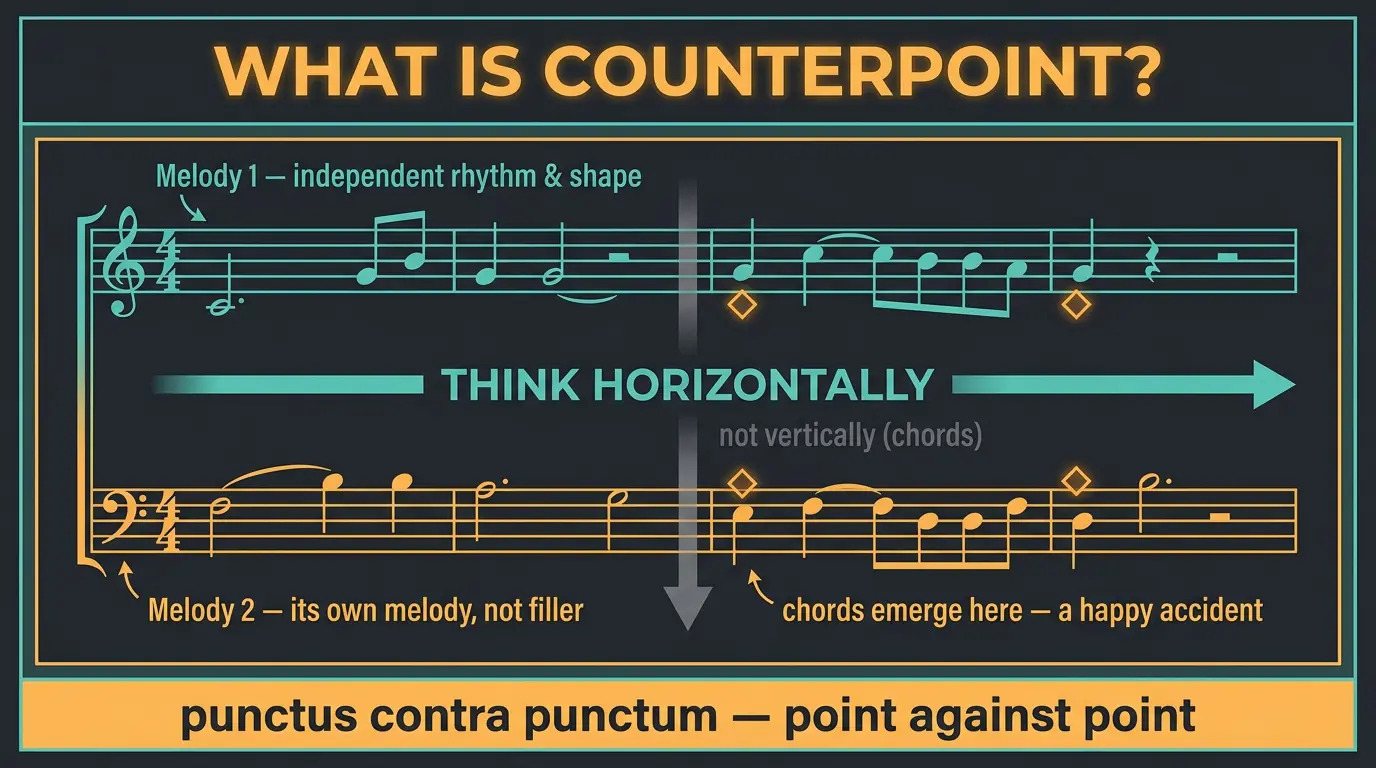
Counterpoint is the relationship between two or more melodic lines that play at the same time. Those lines are harmonically dependent on each other, but they stay independent in rhythm and shape. Each one is its own melody, not just filler supporting the main tune.
The word comes from the Latin punctus contra punctum — "point against point," or note against note. That's the whole idea in two words.
Here's the counterpoint basics mindset that trips people up: you're thinking horizontally, not vertically. Most of us write chords first and melodies second. In counterpoint you write the lines first, and the chords that pop out where they overlap are almost a happy accident. The melodies lead. The harmony follows.
Counterpoint vs. harmony vs. polyphony
These terms get tossed around like they're the same thing. They're not, but the differences are simple.
- Polyphony is the broad term — two or more independent lines happening at once.
- Counterpoint is a slice of polyphony where each line is a real melody woven into the whole, not just a stray voice.
- Homophony is melody plus accompaniment — one tune out front, chords backing it up.
Real arrangements mix all of these. A verse might be homophonic, the chorus might get contrapuntal when a backing vocal starts doing its own thing. You're not picking one texture for the whole song. You're reaching for whichever one serves the moment.
The four types of motion (and why contrary motion wins)
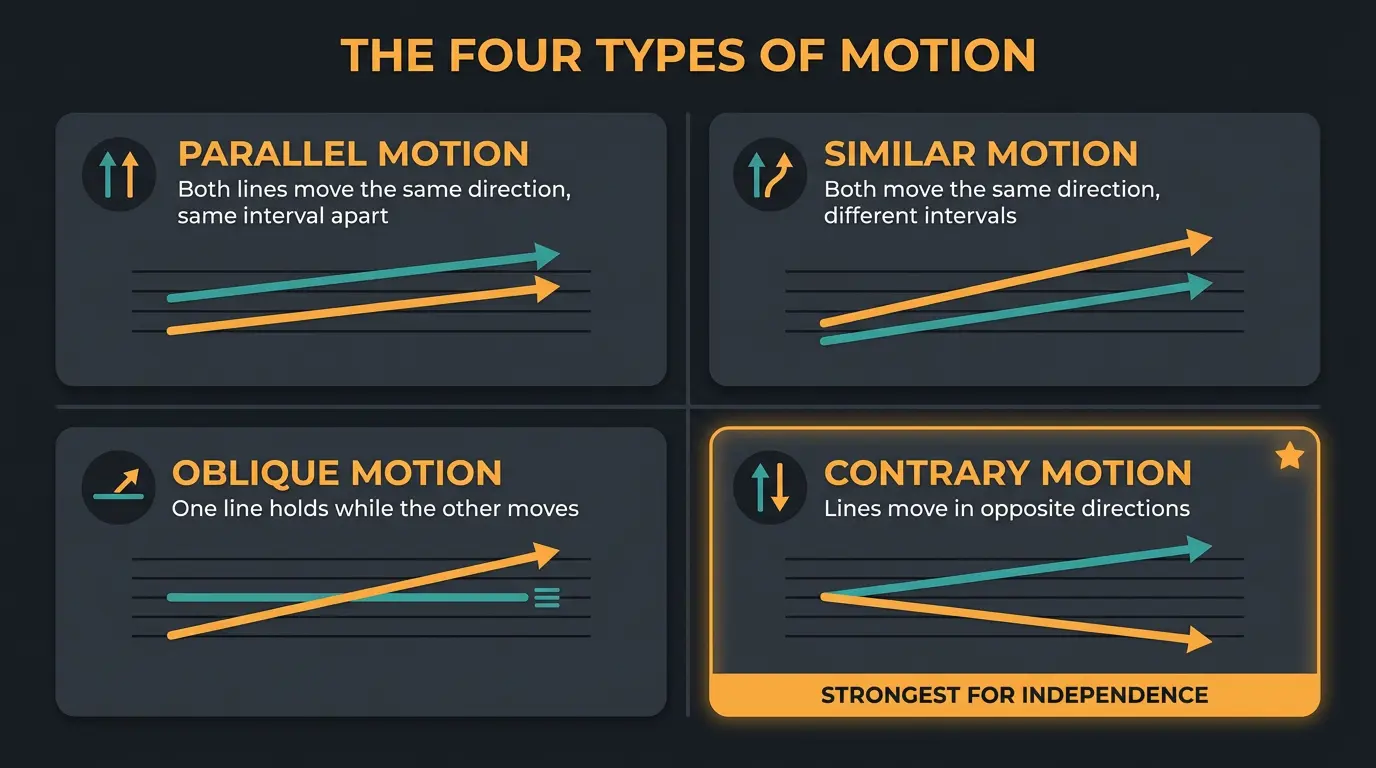
When two lines move, there are only four ways they can relate to each other. Knowing them gives you real control over how independent your melodic counterpoint feels.
- Parallel motion: both lines move the same direction, staying the same interval apart (think moving in thirds).
- Similar motion: both move the same direction, but by different intervals.
- Oblique motion: one line holds a note while the other moves.
- Contrary motion: the lines move in opposite directions — one goes up while the other goes down.
Contrary motion is the star here. When one line climbs and the other drops, your ear hears two clearly separate ideas. It's the strongest tool you've got for making lines feel independent, so reach for it first.
And the lines don't have to mirror each other note for note. Your melody can jump up a fourth while the bass eases down a step. Opposite directions is enough to do the work.
Why independence is the whole point
All that motion talk serves one goal: the two lines should sound independent while still clearly belonging together. That's the balancing act. Too independent and it's noise. Too locked together and it's one thick line pretending to be two.
This is where the famous "no parallel fifths or octaves" rule comes from. People treat it like dogma, but the reasoning is simple. When two voices move in perfect lockstep at a fifth or octave, your ear fuses them into a single sound with a new timbre — like an organ stop that stacks intervals onto one key. The two voices stop being two voices.
So the rule isn't moral law. It's a side effect of wanting independence. If independence is your goal, long parallel runs work against you. If you want that fused, powerful sound, break the rule on purpose. More on that in a second.
Counterpoint in songs you already know
This isn't just a Baroque thing. You've been hearing counterpoint your whole life.
Paul McCartney is a counterpoint machine. On "Come Together," that bassline isn't just holding down roots — it's a melody in its own right, weaving against the vocal. And "Blackbird" is basically fingerpicked counterpoint, with the inner lines moving against the melody. He built it loosely on Bach's Bourrée in E minor, which was itself written as counterpoint for lute.
Now, rules broken on purpose: Bill Withers' "Lean On Me" leans hard into parallel motion between the melody and bass. By the "independence" rulebook that's a no-no, but here it's the hook. That locked-together movement is the whole feel of the song. Intent beats rulebook.
There's also the party-trick version — two separate songs that happen to fit on top of each other. "Frère Jacques" and "Three Blind Mice" sing together just fine. It's a fun demo of the concept, though I'd file it under novelty more than songwriting tool.
How to use counterpoint in your arrangements
Here's the practical payoff. A few of these you can try tonight.
Start with your bass. Move your lead melody in the opposite direction of your bassline and you get instant independence — that pleasant push-and-pull between the two lines. You don't need matching intervals. Just opposite directions. This pairs nicely with knowing how to find chords for a melody, since the chords tend to fall out of where the lines cross.
Next, stop harmonizing everything in parallel. Background vocals, a horn line, a string part — give one of them its own little melodic idea that enters and answers the lead instead of shadowing it a third below. One independent line adds more life than three parallel ones.
Then there's invertible counterpoint, which is a sneaky way to get two ideas out of one. Take your two lines and swap them — put the bass line on top and the melody underneath. The contours stay the same, but it sounds fresh. Great for a second verse or a bridge section when you want variety without writing from scratch.
Make sure you trust your ears through all of this. There isn't one right way to do counterpoint, and the "rules" are guidelines, not a cage.
Counterpoint cheat sheet
- Lead with contrary motion — opposite directions give you the strongest sense of two independent lines.
- Keep your lines rhythmically distinct so the ear can tell them apart.
- Avoid long runs of parallel fifths and octaves unless you want them as a deliberate hook, Lean On Me style.
- Swap your top and bottom lines (invertible counterpoint) to get a second idea out of one.
A quick word on species counterpoint
If you dig deeper, you'll run into "species counterpoint." It's the old-school teaching method laid out in Johann Joseph Fux's Gradus ad Parnassum, and it builds in five stages — from plain note-against-note up through freer, more complex rhythms layered over a fixed melody. It's a genuinely great practice framework for training your ear and your voice leading. For a deeper history, the Wikipedia entry on counterpoint covers it well. But you do not need to grind through all five species to write good counterpoint today — plenty of great lines came from people who never heard the term.
Frequently Asked Questions (FAQs)
What does counterpoint mean in simple terms?
Counterpoint is two or more melodies played at the same time that stay independent but still sound good together. Each line is its own tune, not just backing for the main one. The name is Latin for "point against point" — note against note.
Is a bassline counterpoint?
Yes, if the bassline is its own melody moving against the tune on top, that's counterpoint. A static root-note bass counts less, but something like Paul McCartney's melodic basslines absolutely qualifies. A vocal with a moving bass underneath is the simplest example there is.
What's the difference between counterpoint and harmony?
Harmony is about the chords — the vertical stack of notes at any moment. Counterpoint is about independent melodies moving horizontally, where the chords just fall out of where the lines overlap. In counterpoint you write the lines first and let the harmony follow.
Why are parallel fifths avoided in counterpoint?
Parallel fifths and octaves are avoided because the two voices fuse into one sound and lose their independence. The whole goal of counterpoint is keeping lines separate, so lockstep perfect intervals work against you. That said, you can break the rule on purpose when you want that fused, powerful effect.
Do I need to study species counterpoint to use it?
No, you don't need species counterpoint to write good counterpoint. It's a great practice framework for training your voice leading, but plenty of memorable lines came from writers who never studied it. Start by moving your melody opposite your bass and trust your ears.
Final Thoughts
Counterpoint isn't a dusty academic subject you need permission to use. It's just the craft of making two melodies coexist, and you've been hearing it in your favorite songs forever. Start small — move your lead against your bass and listen to how much room it opens up.
Less is more here. One independent line in the right spot does more than a wall of parallel harmonies. Trust your ears, break a rule or two on purpose, and see what sticks.
Some of the links within this article are affiliate links. These links are from various companies such as Amazon. This means if you click on any of these links and purchase the item or service, I will receive an affiliate commission. This is at no cost to you and the money gets invested back into Audio Sorcerer LLC.