A bridge is a contrasting section that breaks up the verse-chorus loop and sets up the return of the final chorus. You'll also hear it called the middle eight. It's not the centerpiece of a song — it doesn't carry the hook or the title — but it's often the most memorable moment in the whole track.
That's the strange thing about bridges. They get the least real estate and still steal the show. In this post I'll cover what a bridge actually does, where it goes, how long it tends to run, and the practical moves for writing one that earns its spot. And one thing most tutorials skip: not every song needs one.
TABLE OF CONTENTS
What a bridge does
A bridge does two jobs. First, it gives a song variety so it doesn't just toggle verse-chorus-verse-chorus until people tune out. Second, it makes the chorus hit harder when it comes back, because you took the listener somewhere new first.
The core mechanic is tension and release. You build a little tension by leaving the familiar parts behind, then you release it by dropping back into that final chorus. After a good bridge, the chorus feels like home.
The word itself has a fun backstory. It comes from the German Steg, a term for a transitional section. It crossed into English in the 1930s, brought over by composers who fled Nazi Germany and ended up writing for Hollywood and Broadway. They used it to describe the same kind of in-between passage we're talking about here.
Where the bridge goes
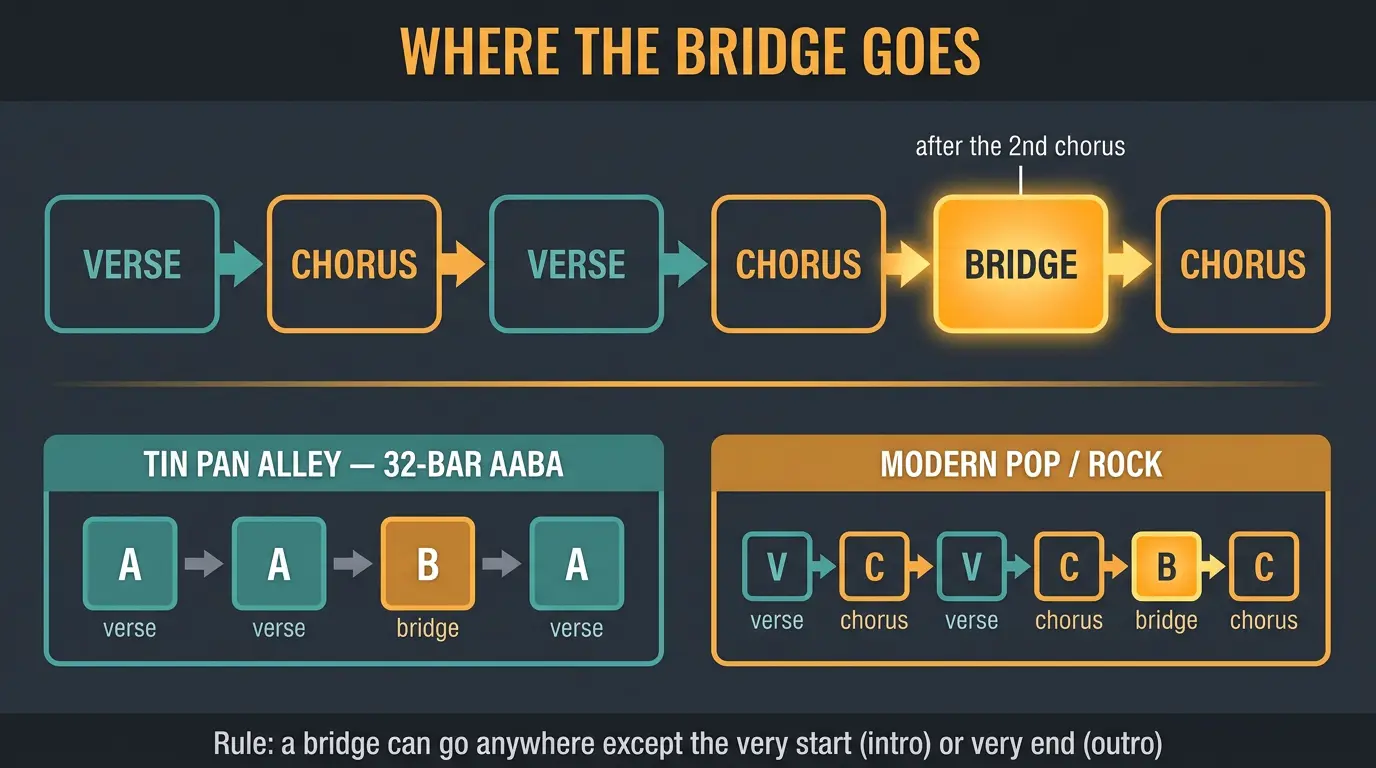
In a modern pop or rock song, the bridge almost always lands after the second chorus, then leads back into the final chorus. The standard flow looks like this:
Verse → Chorus → Verse → Chorus → Bridge → Chorus
There's really only one hard rule about placement: a bridge can go almost anywhere except the very start or the very end. Put it at the start and it's an intro. Put it at the end and it's an outro. Everywhere in between is fair game.
It's worth knowing the older form too. Tin Pan Alley songs followed a 32-bar AABA shape, where the A sections are the verses and the B section is the bridge — the contrasting middle. When rock and roll pushed the chorus to the front, the bridge stuck around but moved into bigger structures. If you want the full map, our guide to song structure breaks down every section.
How long should a bridge be
There's no hard rule, but many bridges run around eight bars. That's exactly why people call it the middle eight.
A common range is roughly 8 to 16 bars. That said, contemporary bridges have gotten longer and more rhythmic than the old standard. A decade or two ago, eight tidy bars was the norm. Now a bridge might run well past 30 seconds and break the bar count entirely. Use what the song asks for.
Creating contrast in the music
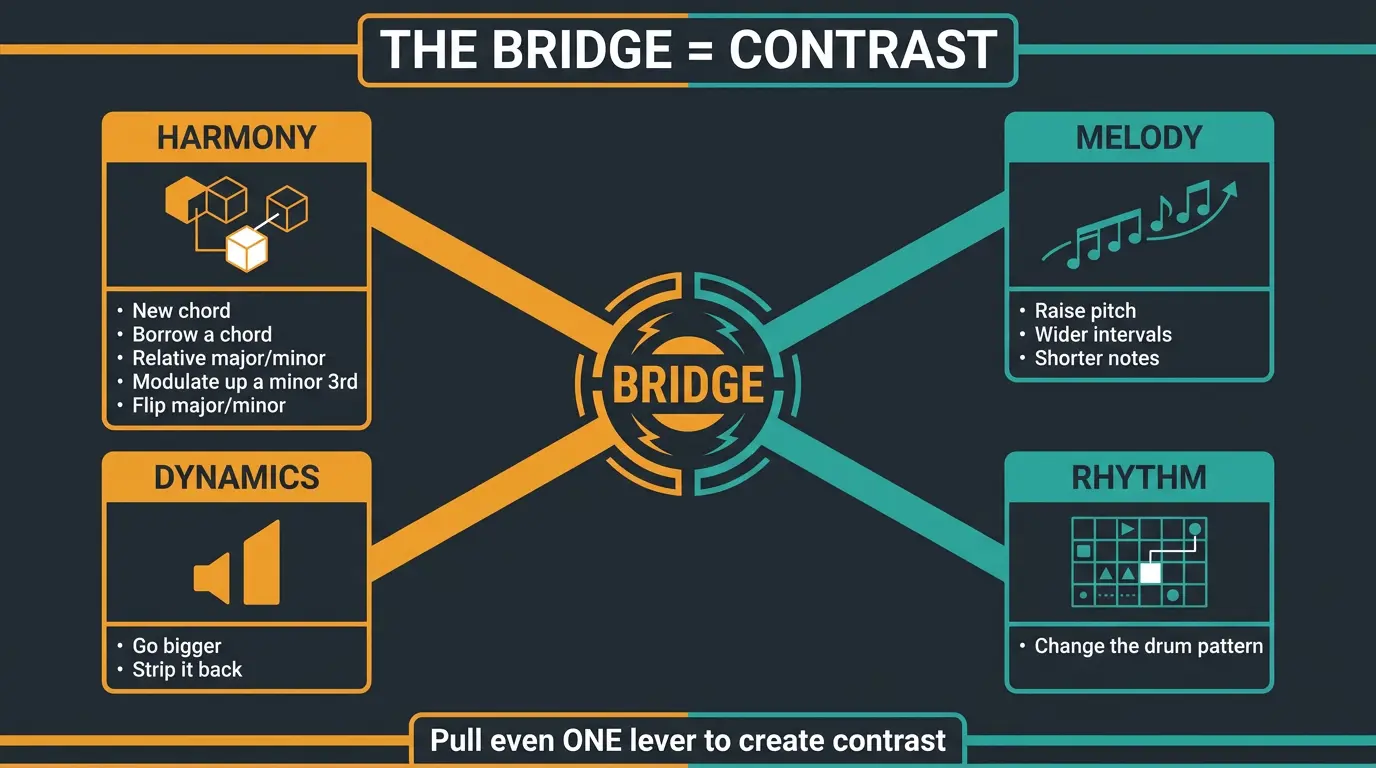
Here's the whole principle in one line: whatever you did in the verse and chorus, do something different here. The bridge is contrast. That's its entire reason for existing.
You've got four levers — harmony, melody, dynamics, and rhythm. You don't have to pull all of them. Even one solid change can do the job.
For harmony, a few moves that work well:
- Start on a new chord you haven't used yet, so the ear knows something shifted.
- Borrow a chord from another key for a jolt of color (a bIII major or bVII major is a classic).
- Switch to the relative major or minor — an easy way to get instant contrast.
- Modulate up a minor third for a lift. If your song's in A major, try the bridge in C major and feel it brighten.
- Flip the chord quality from the chorus — if the chorus leans major, lean minor here.
If you're new to borrowing chords, our piece on major vs minor chords is a good warm-up. For melody, you can raise the pitches, use wider intervals, or shorten the note lengths to add energy. For dynamics, go bigger or pull way back and strip it down — either works, as long as it changes when the bridge arrives.
And don't sleep on rhythm. Changing the drum pattern in the bridge is one of the simplest, most powerful moves there is. It tells the listener, plainly, that we're somewhere new.
Writing the bridge lyric
The musical contrast matters, but the lyric is where a bridge really pays off. The big idea: offer a contrasting point of view. Don't keep telling the verse story, and don't recap the chorus. Look at the same situation from a different angle.
One framing I find genuinely useful comes from Berklee's take on writing bridges: if your verses and chorus describe how things are or how they've been, the bridge can look at how things will be from now on. It's the spot for a final glimpse of the character's transformation, or the moment the whole song turns.
You can also shift perspective — go from specific details to a universal truth, or from present tense to looking back. And here's the freeing part: the bridge doesn't owe anything to the rhyme scheme or rhythm you set up earlier. If there's a line you couldn't fit anywhere else, this is where it goes. It's the natural home for a twist. For more on lines that land, see how to write lyrics that actually connect.
Quick bridge-writing checklist
- Change the melody, harmony, or rhythm from the sections around it — contrast is the whole point
- Place it after the second chorus, leading back into the final chorus
- Aim for roughly 8 to 16 bars, longer if the song wants it
- Give it a contrasting lyrical angle instead of continuing the verse or recapping the chorus
- Use it to set up the final chorus, not to steal the hook or the title
Does every song need a bridge?
Short answer: no. Plenty of great songs skip it entirely. "Jolene" doesn't have one. Neither does Justin Bieber's "Sorry." Nobody's out there feeling cheated.
If your song already has enough variety and momentum, you have full permission to leave the bridge out. Forcing one in just because the template says so can drag a tight song down. Whole genres barely touch them — folk, blues, punk, and a lot of hip hop get along fine without.
So make sure you trust your ears here. A bridge is a tool, not a requirement. Less is more, and that goes for whole sections too. If the song doesn't ask for one, don't write one.
Frequently Asked Questions (FAQs)
What is a bridge in a song?
A bridge is a contrasting section that breaks up the repeating verse-chorus pattern and sets up the return of the final chorus. It's also called the middle eight. It usually doesn't carry the hook or title, but it often delivers a song's most memorable, surprising moment.
Where does the bridge go in a song?
The bridge usually goes after the second chorus, then leads back into the final chorus. The one hard rule is that it can land almost anywhere except the very beginning or the very end — at the start it'd be an intro, at the end an outro.
How long should a bridge be?
There's no hard rule, but many bridges run around eight bars, which is why it's nicknamed the middle eight. A range of 8 to 16 bars is common. Modern bridges have grown longer and more rhythmic, so let the song decide rather than forcing a count.
What's the difference between a bridge and a middle eight?
There's no difference — they're two names for the same thing. "Middle eight" comes from bridges traditionally running about eight bars and sitting in the middle of the song. Use whichever term you like; they point to the same contrasting section.
Does every song need a bridge?
No. Plenty of great songs skip the bridge, like "Jolene" and "Sorry." If your song already has enough variety and momentum, you can leave it out. Some genres — folk, blues, punk, and a lot of hip hop — rarely use them at all.
Final Thoughts
A bridge isn't magic. It's contrast with a purpose — take the listener somewhere new for a few bars, then drop them back into the chorus so it lands harder than before. Get the contrast right in both the music and the lyric and the rest tends to fall into place.
So write one, sit with it, and ask whether the song is actually better for it. If it is, great. If not, cut it loose and don't look back. Trust your ears over the template every time.
Some of the links within this article are affiliate links. These links are from various companies such as Amazon. This means if you click on any of these links and purchase the item or service, I will receive an affiliate commission. This is at no cost to you and the money gets invested back into Audio Sorcerer LLC.