A seventh chord is a triad with one more note stacked on top — the seventh above the root. If a basic major or minor chord stacks two thirds, a seventh chord stacks three. That's the whole idea.
Here's the part that trips people up: "seventh chord" isn't one chord. It's an umbrella covering several types, and only one of them is the dominant 7th everybody's heard of. That one extra note is what takes you from plain to colorful, from happy or sad to dreamy, bluesy, tense, or downright spooky.
In this post I'll break down the five common types, what each one actually sounds like, why some of them feel so tense, and where they get used across genres. Plus a few voicing tips so they don't turn your mix to mud.
TABLE OF CONTENTS
What is a seventh chord?
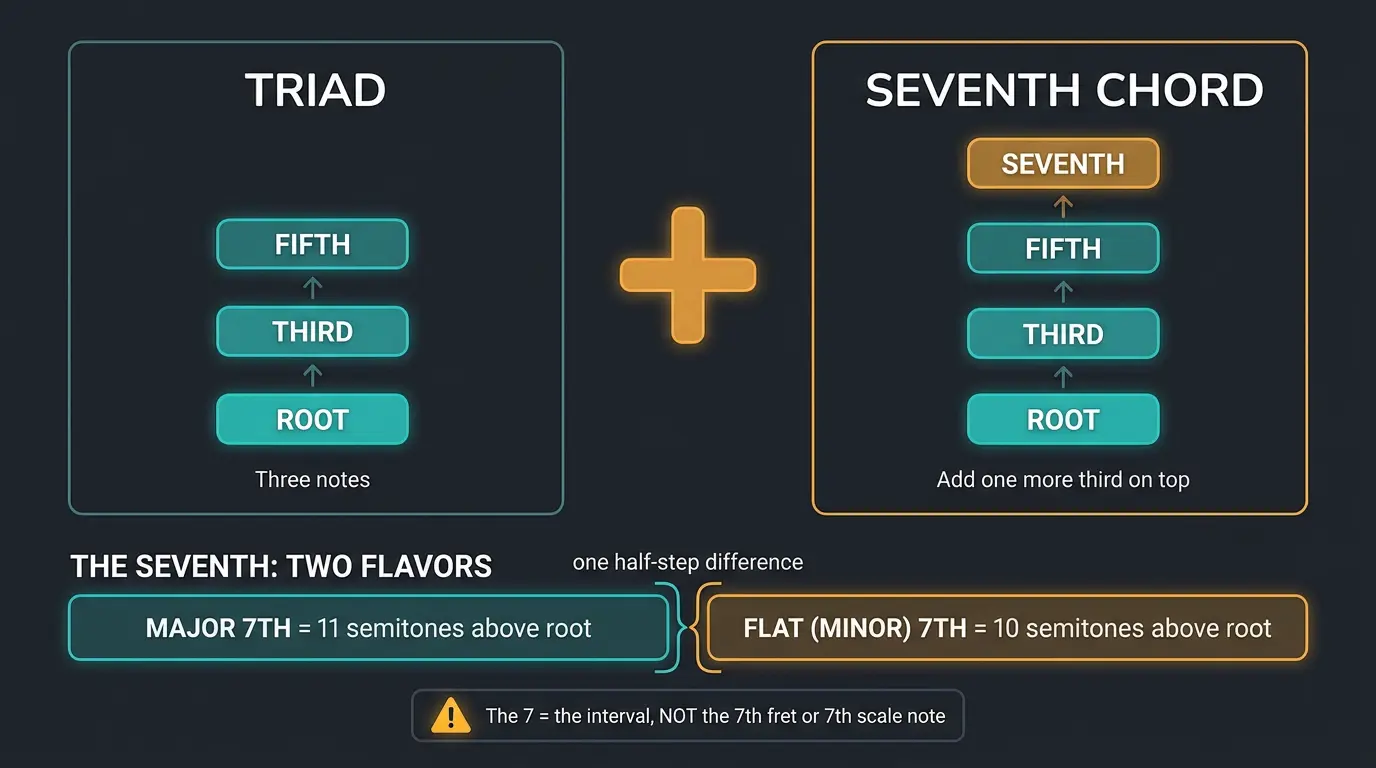
A triad is three notes: the root, the third, and the fifth. A seventh chord adds a fourth note — the seventh interval above the root. You're just stacking one more third on top of the pile.
That seventh can come in two flavors. A major seventh sits 11 semitones above the root. A flat (or minor) seventh sits 10 semitones above. That single half-step difference matters a lot, and it's where most of the confusion lives. The quality of the triad plus the quality of the seventh is what gives you the chord type.
One quick thing to clear up: the "7" doesn't mean play the seventh fret or the seventh note of some scale. It refers to the interval of a seventh above the chord's root. That's it.
The five common seventh chord types
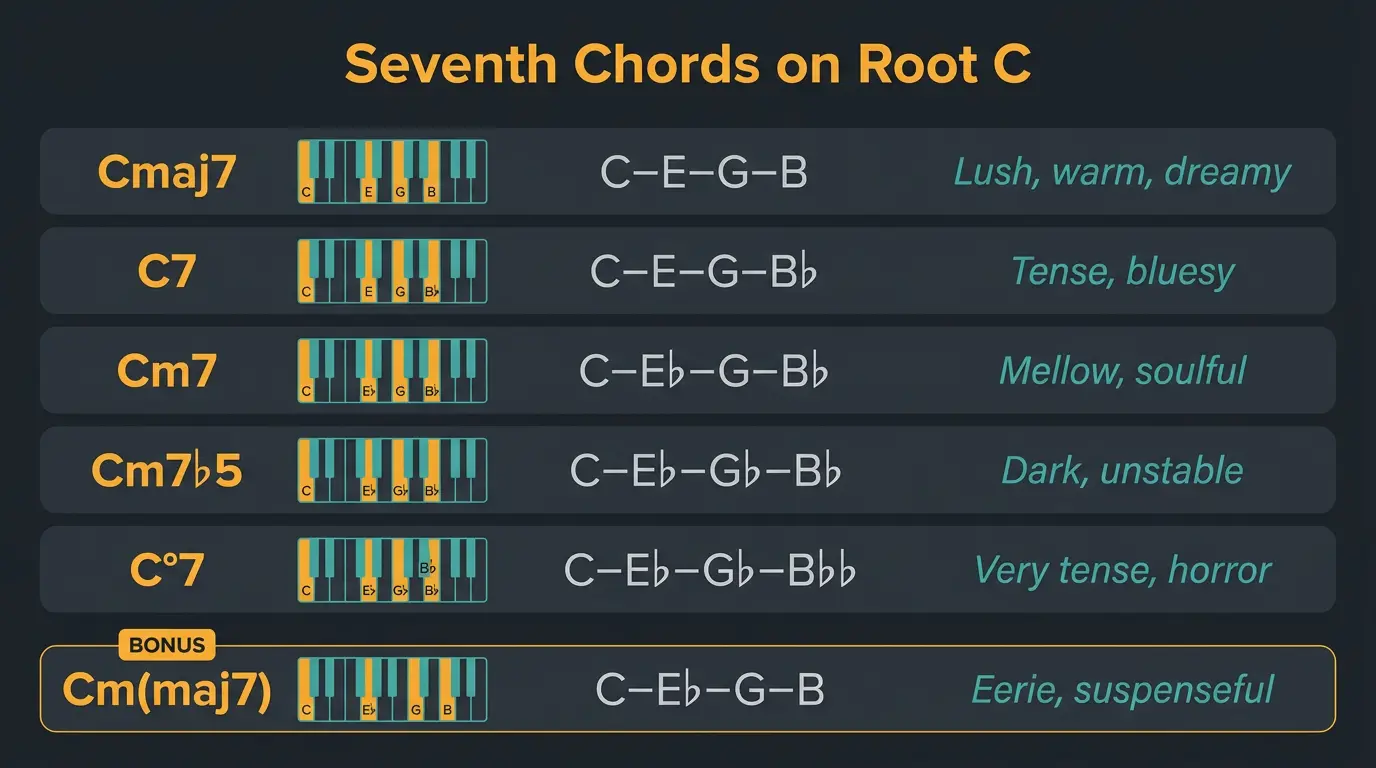
I'll use C as the root the whole way through so you can compare them apples to apples. Same root, different notes on top, totally different feel.
- Major 7th (Cmaj7): C–E–G–B. Lush, warm, dreamy. A major triad with a major seventh on top. Stable but floaty — it doesn't feel like it has to go anywhere.
- Dominant 7th (C7): C–E–G–B♭. Tense and bluesy. Major triad, flat seventh. When you see a plain "7" with no other word, it always means dominant. This one wants to resolve.
- Minor 7th (Cm7): C–E♭–G–B♭. Mellow and soulful. A minor triad with a flat seventh. Relaxed, smooth, a little melancholy without being heavy.
- Half-diminished (Cm7♭5): C–E♭–G♭–B♭. Dark and unstable. A diminished triad with a flat seventh. You'll hear it as the gloomy setup chord in a lot of minor-key tunes.
- Fully diminished (C°7): C–E♭–G♭–B♭♭. Very tense, horror-movie stuff. Every interval is a minor third, which makes it perfectly symmetrical and deeply restless.
There's a sixth one worth a mention: the minor-major 7th (C–E♭–G–B), a minor triad with a major seventh. Eerie, suspenseful, kind of a spy-thriller color. Use it when you want unsettling.
Don't overthink which one is "right" for a moment. Trust your ears — each of these has a thousand homes.
The five types at a glance
- Major 7th — warm, lush, dreamy, and stable.
- Dominant 7th — tense and bluesy, and it wants to resolve.
- Minor 7th — mellow, smooth, and soulful.
- Half-diminished — dark, unstable, and melancholic.
- Fully diminished — very tense and suspenseful, the horror-movie chord.
Why dominant and diminished chords sound tense: the tritone
Here's the single most useful "why" in all of this. In a dominant 7th and in diminished chords, the distance between the third and the seventh is a tritone — three whole steps, the most restless interval in Western music. That dissonance is what creates the pull.
Take C7. The E (the third) wants to climb up to F. The B♭ (the seventh) wants to slide down to E. Both notes are leaning, and when they finally land, you feel the release. That little push-and-pull is the engine behind most chord progressions you've ever heard.
So when a dominant chord feels like it's begging to move somewhere, it's not your imagination. The tritone is doing the begging.
Seventh chords in a major key
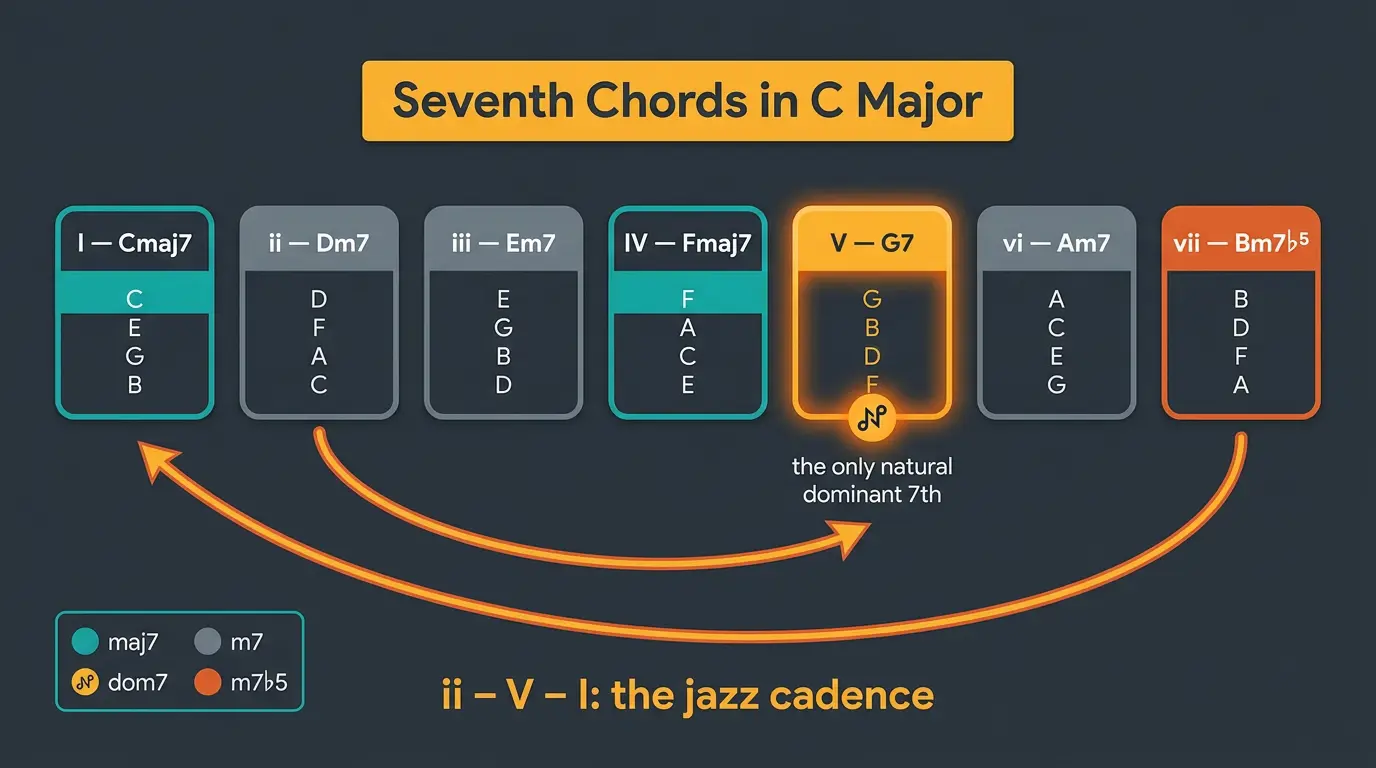
If you build a seventh chord on each note of the C major scale, here's what you get:
- I — Cmaj7
- ii — Dm7
- iii — Em7
- IV — Fmaj7
- V — G7
- vi — Am7
- vii — Bm7♭5
The pattern is maj7, m7, m7, maj7, dom7, m7, m7♭5. Memorize that and you've got every diatonic seventh chord in any major key. If chord-by-scale-degree thinking is new to you, our piece on the chords in the key of C walks through it from the triad side first.
Notice the dominant 7th only shows up naturally on one spot — the fifth degree (G7). That's no accident. It's the only chord in the key with that tritone, which is exactly why V pulls home to I. Play G7 to Cmaj7 and you hear the whole story resolve.
String it together as ii–V–I — Dm7 to G7 to Cmaj7 — and you've got the most important cadence in jazz. It's the backbone of thousands of songs.
Where seventh chords show up
Let's knock down a myth first: seventh chords are not just a jazz thing. They're everywhere.
In jazz, sure, they're the default vocabulary. Plain triads are actually rare, and the ii–V–I shows up constantly. If you want to go deeper there, our beginner's intro to jazz chord progressions is the next stop.
Blues and R&B lean hard on the dominant 7th — and they put it on the I, IV, and V, which is harmonically unusual but gives you that gritty bluesy sound. The 12 bar blues is built on it. Soul, neo-soul, and bossa nova reach for maj7 and min7 for that warm, smooth feel. Pop and rock use maj7 and dom7 for color and turnarounds.
And film and classical scores love the diminished family — dim7 for suspense and sneaky modulations, half-diminished for melancholy. Same four-note idea, wildly different jobs.
Voicing seventh chords so they don't muddy your mix
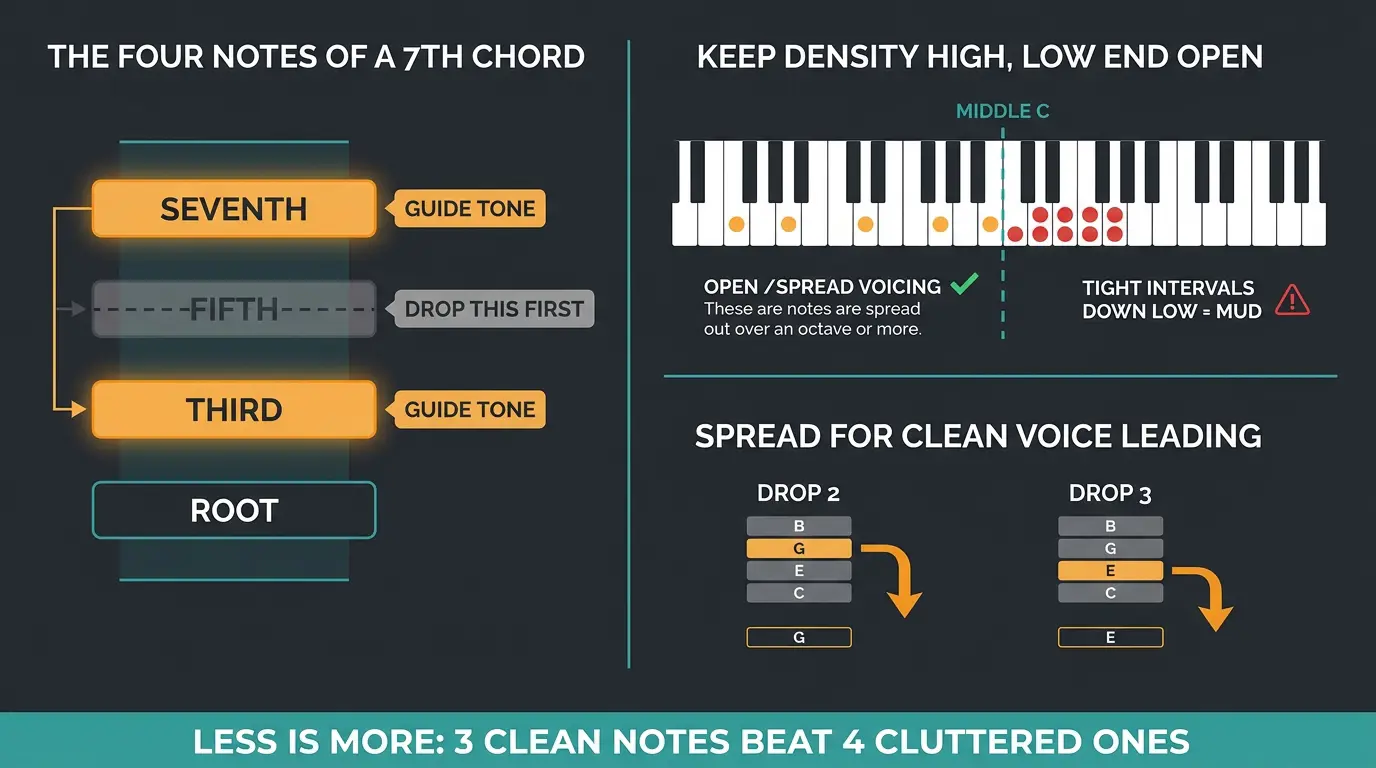
Here's where the producers in the room should lean in. A seventh chord is four notes, but you don't have to play all four. The third and the seventh are the guide tones — they define the chord's quality. The fifth adds the least, so it's the first note you can drop.
Seventh chords also pack their intervals closer together than triads do. Stack those tight intervals down low and you get mud, fast. So keep the dense stuff up higher, and below middle C use open, spread voicings to let the low end breathe.
For smooth movement between chords, look into drop 2 and drop 3 voicings — they're the standard way players spread these out for clean voice leading. If inversions are still fuzzy for you, our guide to chord inversions explained simply pairs perfectly with this. Less is more. A clean three-note voicing almost always beats a cluttered four-note one.
Where to go next: extended chords
Once seventh chords click, you've got the keys to the whole kingdom. Keep stacking thirds and you land on 9ths, 11ths, and 13ths — the extended chords that give jazz and neo-soul their rich, layered sound.
And don't forget: a seventh chord has four notes, so it has root position plus three inversions. The seventh in the bass gives you that third inversion. Plenty to explore before you ever add a ninth.
Frequently Asked Questions (FAQs)
What is a seventh chord?
A seventh chord is a triad — root, third, and fifth — with a fourth note added a seventh above the root. You're just stacking one more third on top of a basic chord. That extra note adds color, and the type of seventh and triad together create different chord qualities.
What's the difference between a maj7 and a dom7 chord?
Both have a major triad underneath, but the seventh is different. A maj7 (C–E–G–B) uses a major seventh and sounds lush and dreamy. A dom7 (C–E–G–B♭) uses a flat seventh and sounds tense and bluesy, like it wants to resolve. This is the most-confused point in the whole topic.
Does "7" mean a dominant seventh chord?
Yes — a plain "7" symbol with no other word always means a dominant seventh, like C7. "Seventh chord" on its own is the umbrella term covering all types, including maj7, min7, and the diminished family. So C7 is dominant, but Cmaj7 and Cm7 are still seventh chords too.
What's the difference between half-diminished and fully diminished?
Both start with a diminished triad, but the seventh differs. A half-diminished chord (Cm7♭5) has a minor seventh and sounds dark but a little softer. A fully diminished chord (C°7) has a diminished seventh, making every interval a minor third — symmetrical, very tense, and restless.
Are seventh chords only used in jazz?
No — seventh chords show up across nearly every genre. Jazz uses them as its default vocabulary, but blues and R&B lean on dominant 7ths, soul and bossa nova use maj7 and min7 for warmth, pop and rock add them for color, and film scores use diminished chords for suspense.
Final Thoughts
Seventh chords are the easiest upgrade you can give your harmony. One extra note, and a plain major chord becomes dreamy, or a plain dominant chord starts pulling toward home. Once you can hear the difference between a maj7 and a dom7, the rest falls into place quickly.
Don't stress about playing all four notes every time — guide tones do most of the work, and a leaner voicing usually sits better in a mix anyway. Make sure you spend a little time just playing each type and listening. Your ears will teach you more than any chart can.
Some of the links within this article are affiliate links. These links are from various companies such as Amazon. This means if you click on any of these links and purchase the item or service, I will receive an affiliate commission. This is at no cost to you and the money gets invested back into Audio Sorcerer LLC.