The verse is the storytelling engine of your song. It's where the actual story develops, line by line, while the chorus tends to repeat and tell you what the whole thing means. Treat the verse like filler between choruses and the whole song goes flat.
A good verse does two jobs at once: it advances the story, and it sets up the chorus to hit harder. Here's how to pull that off — the verse's narrative role, how to build toward the chorus, and the melodic restraint that gives the chorus somewhere to go.
TABLE OF CONTENTS
What a verse is actually for

The verse is where your story develops in a linear progression. Each verse moves things forward — new details, new moments, the next beat of the narrative. That's its core job.
The chorus works the other way. It usually repeats the same lyrics every time and says what a moment means. So the verse is specific and narrative; the chorus is universal and declarative. A verse tells you about sitting in a parking lot after a breakup. The chorus tells you what that moment means.
How much weight the verse carries depends on the genre. Pop hits are usually built around a big, climactic chorus, so the verse mostly serves the setup. Folk, rap, and musicals lean the other way — the verses carry the story, and the chorus is more of a breather. Neither is right or wrong. Know which one you're writing.
How to structure a verse across a song
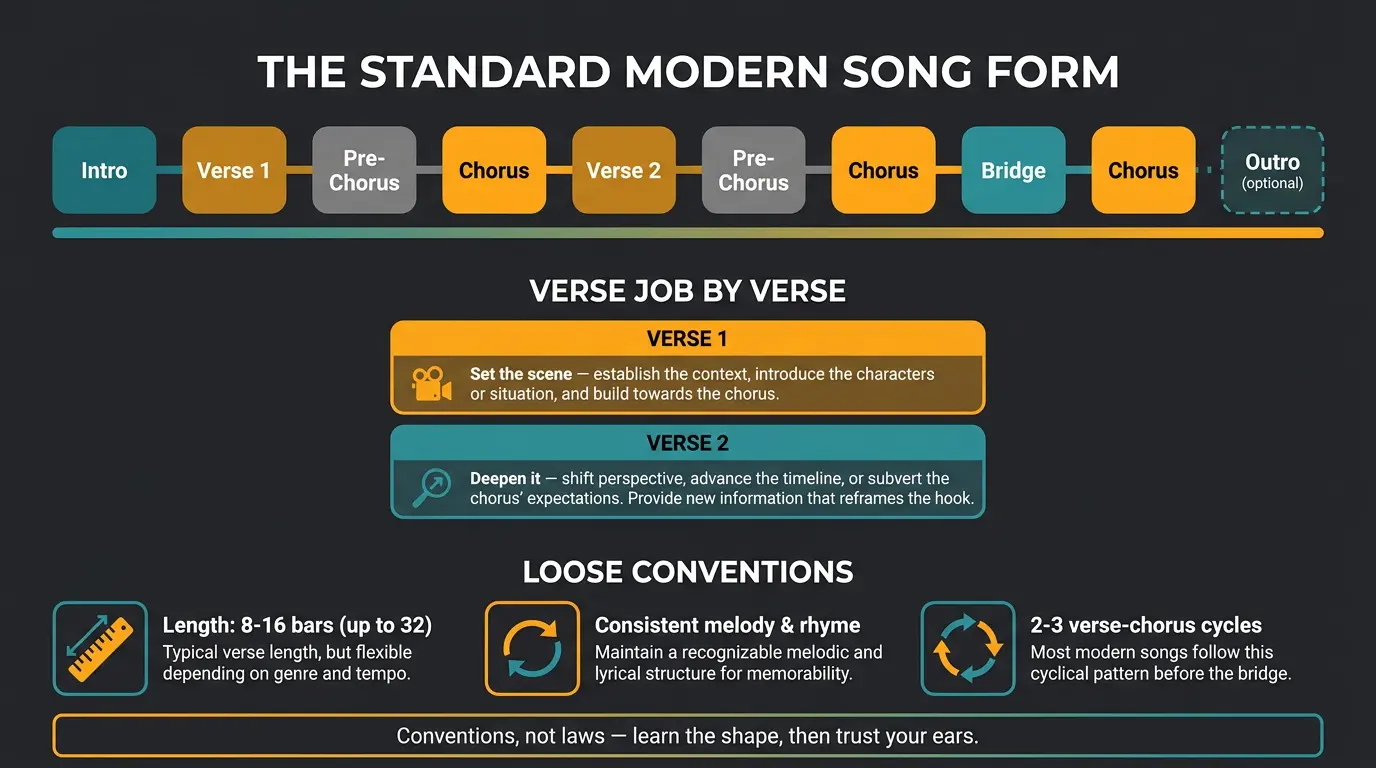
Here's a simple framework. Verse one sets the scene. Verse two deepens it — shift the perspective, advance the timeline, or recolor what came before. Some of the best songs use verse two to subvert the meaning of the chorus entirely, so the same words land differently the second time you hear them.
There are some loose conventions worth knowing. Verses tend to stick to a consistent length — commonly 8 to 16 bars, sometimes 16 or 32 depending on the genre. They usually share a similar melody and rhyme scheme each time. And most songs run two or three verse-chorus cycles, no more.
The standard modern form goes intro, verse, pre-chorus, chorus, verse, pre-chorus, chorus, bridge, chorus, with an optional outro. If you want to go deeper on the map of how these pieces fit together, the Wikipedia entry on song structure is a solid reference.
With that being said, these are conventions, not laws. Plenty of great songs break every one of them. Learn the shape so you know what you're bending, then trust your ears.
Building toward the chorus
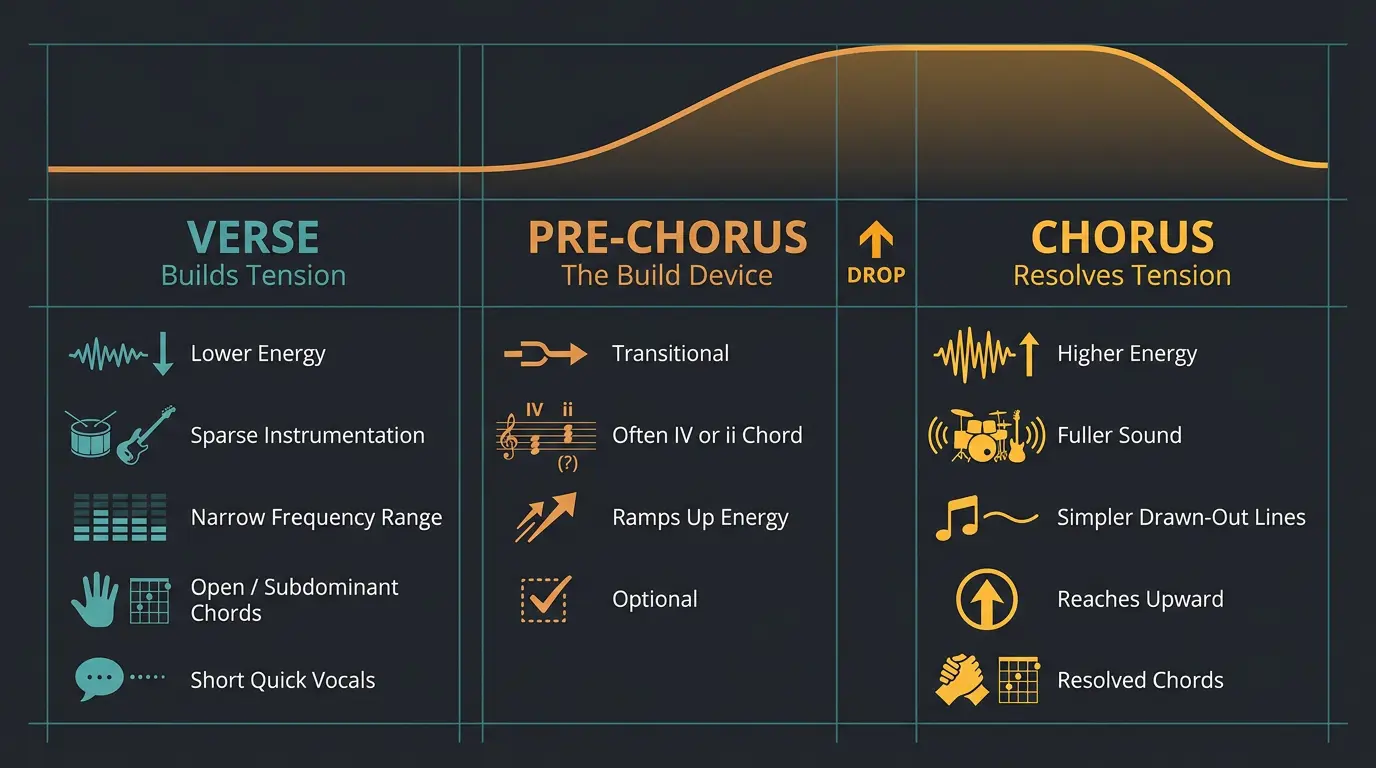
The verse creates tension. The chorus resolves it. That's the engine underneath the whole thing.
Verses usually run lower in energy, with sparser instrumentation and a narrower frequency range. Harmonically, they often sit on open or subdominant chords that signal the musical statement isn't finished yet — that unresolved feeling is doing real work. Short, quick vocal rhythms add to the unsettled pull, and the chorus answers with simpler, drawn-out lines that reach upward.
Here's a test you can run on your own song: each time the chorus returns, the verse before it should make it land differently. If the chorus means the same thing the second time as it did the first, your verses aren't doing their job.
The pre-chorus is the dedicated build device — a short transitional section, often on the IV or ii chord, that ramps things up right before the drop into the chorus. Not every song needs one, but when a chorus feels like it arrives out of nowhere, a pre-chorus is often the fix.
Melodic restraint: give the chorus somewhere to go
This is the most actionable part, and it's where less is more really earns its keep. Write your verse melody in a comfortable, lower, conversational register. If the verse already sits at the top of your range, the chorus has nowhere to climb — and the whole song stays on one level.
The simplest way to avoid that trap is to keep the verse melody low and give yourself plenty of room to move up in the chorus. There's a bonus, too: when the chorus vocal jumps higher, the voice generates more harmonics up top, so it sounds brighter and cleaner on its own. You get a lift for free just from pitch.
Restraint matters in the arrangement, and this one's for the recording and producing crowd. Save the wow factor. In the verse, maybe the guitars are palm-muted instead of playing open chords, the drums are just kick and snare instead of the full kit, and a keyboard part drops out entirely. Then the chorus brings all of it back in.
Choruses generally have at least as many instruments as the verse, if not more. That contrast is what makes the chorus feel like an event. If everything's playing the whole time, nothing has room to open up.
Lyric craft: show, don't tell
Paint a picture instead of naming the emotion. Don't write "heartbreak." Write the jacket still hanging on the hook by the door, or the text that got delivered but never read. A concrete image makes a listener feel something instead of just recognizing a category.
Don't overdo it, though. Simple, clear, and specific beats clever and abstract every time. If a metaphor needs a footnote, cut it.
Then there's prosody, which just means the alignment between your words and your melody. The practical move: speak your lines out loud and mark where the natural stresses fall. Make sure those stressed syllables land on strong beats. When the words and the melody stress the same spots, the line sings itself. Keep syllable counts consistent from verse to verse so your lines actually fit the melody later.
Rhyme is a tool, not a requirement. A few schemes worth having in your pocket:
- AABB — couplets, punchy and easy to follow.
- ABAB — alternating, feels a little more sophisticated.
- ABCB — only the even lines rhyme, very common in folk and pop.
- Slant rhyme — near-rhymes like "home" and "alone," great when a perfect rhyme feels forced.
If you want to go deeper on the words themselves, we've got a full breakdown on how to write lyrics that actually connect.
A quick editing pass for any verse
Once you've got a rough verse, run these three passes on it in order. It works on anything.
- Image pass. Underline every abstract word. Replace at least half of them with a concrete detail — a specific object, place, or action.
- Prosody pass. Speak the lines aloud and mark the stresses. Any stress that fights the beat, rewrite until it lands where the music wants it.
- Alternate lines. Take your weakest line and write it two different ways. Keep whichever version strengthens the imagery, the rhythm, or the rhyme.
One bit of nuance: cut lines that don't serve the song, but don't get ruthless with every small detail. Sometimes a throwaway thing — the color of someone's hair — carries real weight and grounds the whole verse. Make sure you use your judgment there instead of a hard rule.
Common verse-writing mistakes
- Treating the verse as filler between choruses. It's often one of the most repeated sections in the song, so make it pull its weight.
- Starting too broad or abstract. Open on a specific image, not a general statement about a feeling.
- Writing the verse melody too high. If it sits at the top of your range, the chorus has nowhere to lift.
- Over-explaining the emotion. Trust the imagery and let the listener feel it instead of telling them how to feel.
Frequently Asked Questions (FAQs)
How long should a verse be?
Most verses run 8 to 16 bars, though some genres stretch to 16 or 32. The exact number matters less than consistency — keep each verse the same length so they share a shape. Treat these as conventions, not rules, and let the song tell you what it needs.
How do you structure a verse?
Structure a verse to advance the story in a linear progression while building tension toward the chorus. Keep the melody in a lower, conversational register, use sparser instrumentation, and land on harmony that feels unresolved. Verse one sets the scene; verse two deepens or shifts it.
Should the second verse be different from the first?
Yes — the second verse should advance the story, not repeat it. Shift the perspective, move the timeline forward, or recolor what the chorus means. Keep the melody and rhyme scheme similar so it feels like the same song, but give the listener new information every time.
Why is my verse boring?
Usually it's too abstract, the melody sits too high, or the arrangement gives away everything upfront. Swap vague emotion words for concrete images, drop the verse melody into a lower register, and strip back the instrumentation so the chorus has somewhere to go.
What's the difference between a verse and a chorus?
The verse tells the story and changes each time; the chorus states what it all means and usually repeats. Verses are specific and narrative, choruses are universal and declarative. The verse builds tension with lower, busier melodies, and the chorus resolves it with simpler, higher lines.
Final Thoughts
A verse isn't the boring part you get through to reach the good stuff. It's where the story lives, and it's the reason the chorus feels like a payoff. Get the verse right and the chorus almost writes itself.
So keep the melody low, the images specific, and the arrangement patient. Then when you're ready to build the part everyone sings along to, we've got you covered on writing a chorus that's actually memorable. Trust your ears and keep at it.
Some of the links within this article are affiliate links. These links are from various companies such as Amazon. This means if you click on any of these links and purchase the item or service, I will receive an affiliate commission. This is at no cost to you and the money gets invested back into Audio Sorcerer LLC.