A good guitar melody starts with chord tones, not random scale runs. Most guitarists noodle up and down a scale shape and wonder why it sounds aimless. The notes are technically correct, but nothing lands.
The fix is simpler than it sounds. Target the right notes, phrase like you mean it, and grow a small idea into something whole. Do that and you'll write lines people actually remember.
TABLE OF CONTENTS
Start with chord tones
Here's the anchor for everything else. A chord is a few notes played together, which means every time a chord sounds, you've already got at least three notes guaranteed to work in your melody. Those are your chord tones.
Play a C chord and you can lean on C, E, and G. Switch chords, and you lean on that new chord's tones instead. It's that direct.
Say you're in the key of G. The G major scale is G A B C D E F#, but you don't want to fire off all seven randomly. If a G chord is ringing out, that chord is G-B-D — so build your line around G, B, and D.
The other scale notes aren't banned. A, C, E, and F# are your passing notes, the connective tissue between the strong landing spots. Land on chord tones, pass through the rest. That one habit cleans up a wandering melody fast.
Use target notes to guide your lines
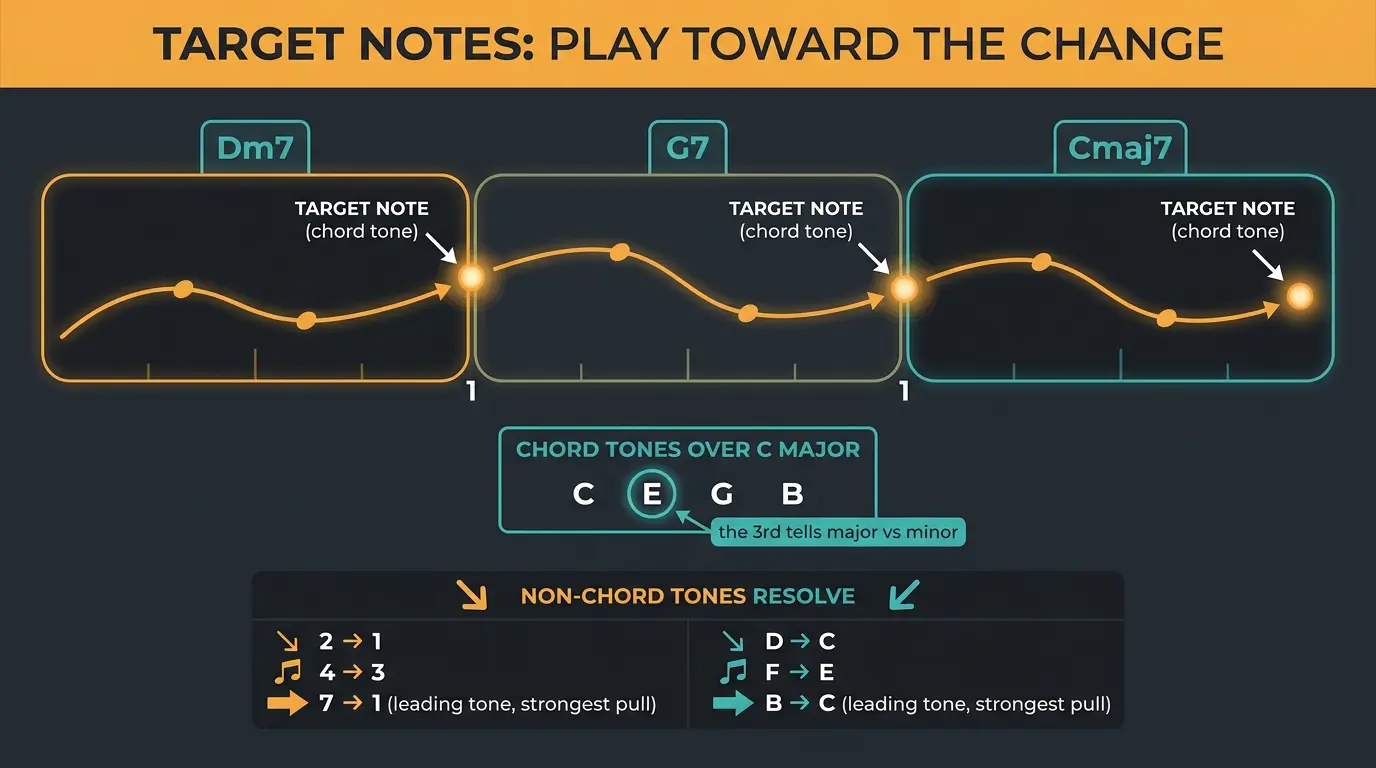
This is where it gets good. A target note is a strong chord tone you aim to land on right as the chord changes — usually beat one of the next bar. You're not just playing over the chord, you're playing toward it.
Start with the 3rd of each chord. It's the easiest to hear and the clearest, because the 3rd is the note that tells your ear whether a chord is major or minor. Over a C major chord, your strong targets are C, E, G, and B.
A scenario where this really pays off is a II-V-I. Try playing a line that hits a chord tone on the downbeat of each chord. Suddenly your phrasing has somewhere to go, because you're already thinking ahead to the next landing spot. That forward-thinking is the whole point — it trains you to hear the next chord coming.
Non-chord tones still work, as long as they resolve. The 2 pulls down to the 1, the 4 pulls to the 3, and the 7 — the leading tone — pulls hard up to the 1. Use that pull on purpose and tension becomes a tool instead of an accident. If you want to go deeper on how notes want to resolve, our guide to music scale degrees breaks down which ones feel stable and which ones don't.
Learn a few scale shapes and the CAGED system
Now the guitar-specific part. The CAGED system takes five open chord shapes — C, A, G, E, and D — and uses them to map the entire neck into five sections. The shape of the major scale stays the same no matter the key, so learning five patterns covers all 12 keys.
The shapes connect in order: C form into A form, A into G, G into E, E into D, and D loops back to C. Memorize that chain and you can move anywhere on the neck without getting lost.
Here's the payoff. Most guitarists live in one box — the pentatonic shape at the 5th fret — and it feels safe, so every solo starts sounding the same. CAGED lets you move horizontally. You can run a melody along a single string, moving through each shape, instead of being stuck in one little rectangle.
The best part for melody writing: each CAGED position contains the chord, the scale pattern, and the arpeggio that outlines the harmony, all in one spot. So the shapes connect right back to the chord-tone idea from earlier — your target notes are sitting inside the shape, waiting for you. If chord shapes are still new, our walkthrough of building guitar chord progressions is a good companion read.
Phrase with intention, not autopilot
This is the heart of the whole thing. Robot mode is ripping through a scale pattern with no variation — up one shape, down the next, over and over. The notes are right. The music isn't there.
There's a real difference between mindless noodling and intentional note choice. Aimless scale-running sounds like someone warming up. The players you love target specific notes and let the harmony guide them.
The mindset shift that fixes this is treating what you play as a part, not a run. A part is a musical idea with shape, direction, and feeling — a riff, a short melody, something that could stand on its own. When you think in parts, you stop filling space and start saying something.
And honestly, less is more here. A handful of well-placed notes with real phrasing will beat a flurry of fast ones every time.
Tricks to stop noodling
- Play like you sing. Sing a phrase over the backing track first, then find it on the fretboard. If you can't hum it, it probably isn't a melody yet.
- Use space and silence. Pauses between notes create tension and release. Leaving a gap is a choice, not a mistake.
- Try call and response. Play a short phrase on the lower strings, then answer it an octave up with a small variation — like a musical conversation.
- Constrain yourself. Limit to three notes, one string, or one position. Constraint forces creativity instead of reflex.
- Slow down. A lot of noodling hides behind speed. Slowing down makes you aware of every note choice and your phrasing.
- Vary your dynamics. Play the same note soft, medium, and hard. Your right-hand attack shapes a line as much as the notes do.
Grow a motif into a melody
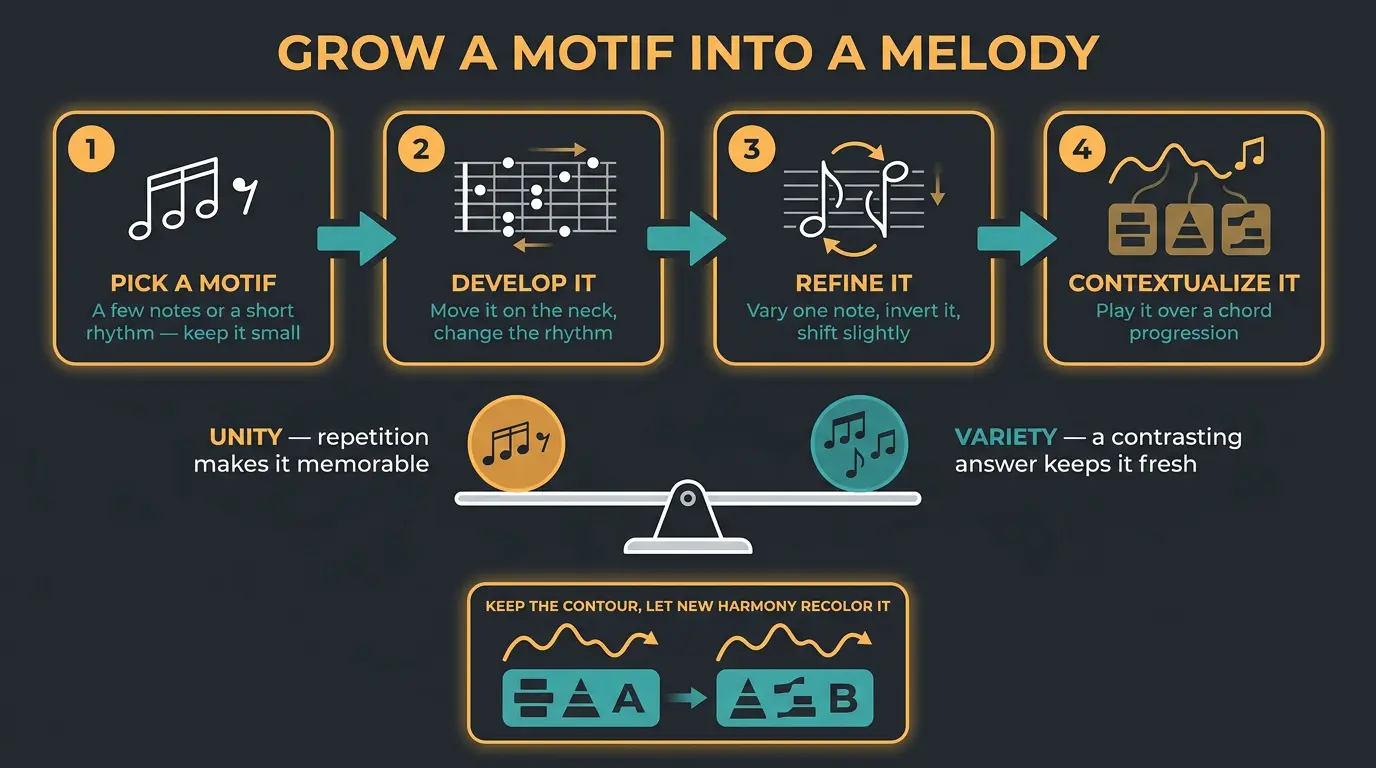
A motif is a short idea — just a few notes that relate to each other. A full melody is really several motifs, repeated and tweaked until they add up to a complete thought. You don't need a finished melody on the first try. You need one small idea you can develop.
Here's a workflow that works:
- Pick a simple motif. A few notes or a short rhythm. Keep it small and manageable.
- Develop it. Instead of repeating it mechanically, move it to different spots on the neck and change the rhythm.
- Refine it. Vary one note. Invert it. Let the idea repeat but shift slightly each time.
- Contextualize it. Play it over a chord progression so it becomes part of a real musical conversation.
The balance you're after is unity versus variety. Repeating a motif gives you unity — it's what makes a line memorable. Following it with a contrasting answer gives you variety, so it doesn't get stale.
One pro move: when the chords change underneath, you can keep the melodic contour — the shape of the line — roughly the same, letting the new harmony recolor it. For more on how shape and attack interact, the Wikipedia overview of guitar picking is a solid reference. And if you want to turn finished melodies into songs, our guide on finding chords for a melody takes it from here.
Frequently Asked Questions (FAQs)
What's the best note to target in a guitar melody?
The 3rd of the chord is the best note to target first. It's the clearest and easiest to hear because it defines whether a chord is major or minor. Land on it as the chord changes, then branch out to roots, 5ths, and 7ths once your ear's comfortable.
What scale should I use to write a guitar melody?
Use the major or minor scale that matches your song's key, and focus on the chord tones within it. A simple approach is major pentatonic over major chords and minor pentatonic over minor chords. The scale gives you the pool of notes, but chord tones are where your melody should land.
How do I stop noodling and sound intentional?
Treat what you play as a part, not a run — a short idea with shape and direction. Slow down, leave space between notes, and target chord tones instead of running scales on autopilot. If you can sing it first, you're already thinking melodically.
Can I use notes outside the chord?
Yes, as long as they resolve. Non-chord tones work as passing notes between your strong landing spots — the 2 resolves to the 1, the 4 to the 3, and the 7 pulls up to the 1. The pull toward a chord tone is what makes them sound intentional instead of wrong.
How many notes should a melody have?
Enough to be interesting, few enough to remember. Too many notes make a melody hard to recall, while too few make it boring. Finding that balance is about phrasing and space, not a fixed number — let the line breathe and lean on repetition to make it stick.
Final Thoughts
Writing guitar melodies isn't luck, and it isn't random noodling through a scale shape. It's targeting chord tones, phrasing with intention, and growing a small idea into something whole. Do that and the notes stop sounding like practice and start sounding like music.
Make sure you trust your ears over any rule in this post. There isn't one right way to write a melody — these are habits that get you there faster. Grab your guitar, pick one motif, and see where it goes.
Some of the links within this article are affiliate links. These links are from various companies such as Amazon. This means if you click on any of these links and purchase the item or service, I will receive an affiliate commission. This is at no cost to you and the money gets invested back into Audio Sorcerer LLC.