A suspended chord takes a regular triad and swaps out the third, replacing it with either a second (that's a sus2) or a fourth (that's a sus4). The root and the fifth stay put. That's the whole move.
Here's why it matters: the third is the note that tells your ear whether a chord is happy or sad. Drop it, and the chord loses its label. It just sits there, open and undecided, waiting for you to do something with it.
If you've already worked through chord inversions and seventh chords, this is a natural next step. Let's get into how sus2 and sus4 are built and why they sound the way they do.
TABLE OF CONTENTS
What are sus chords?
A suspended chord is a triad with the third taken out and something else put in its place. That's it. And that one swap changes everything about how the chord feels.
Think about it this way. A C major chord has an E in it. A C minor chord has an E flat. That third is the note doing all the emotional work. A sus chord has neither one, so nothing in the chord is telling you happy or sad. It's tonally ambiguous, and that's the point.
Both sus2 and sus4 keep the root and the perfect fifth. They only touch the third. You'll hear them all over pop, rock, and jazz, because that open, non-committal sound is genuinely useful.
How to build sus2 and sus4 chords
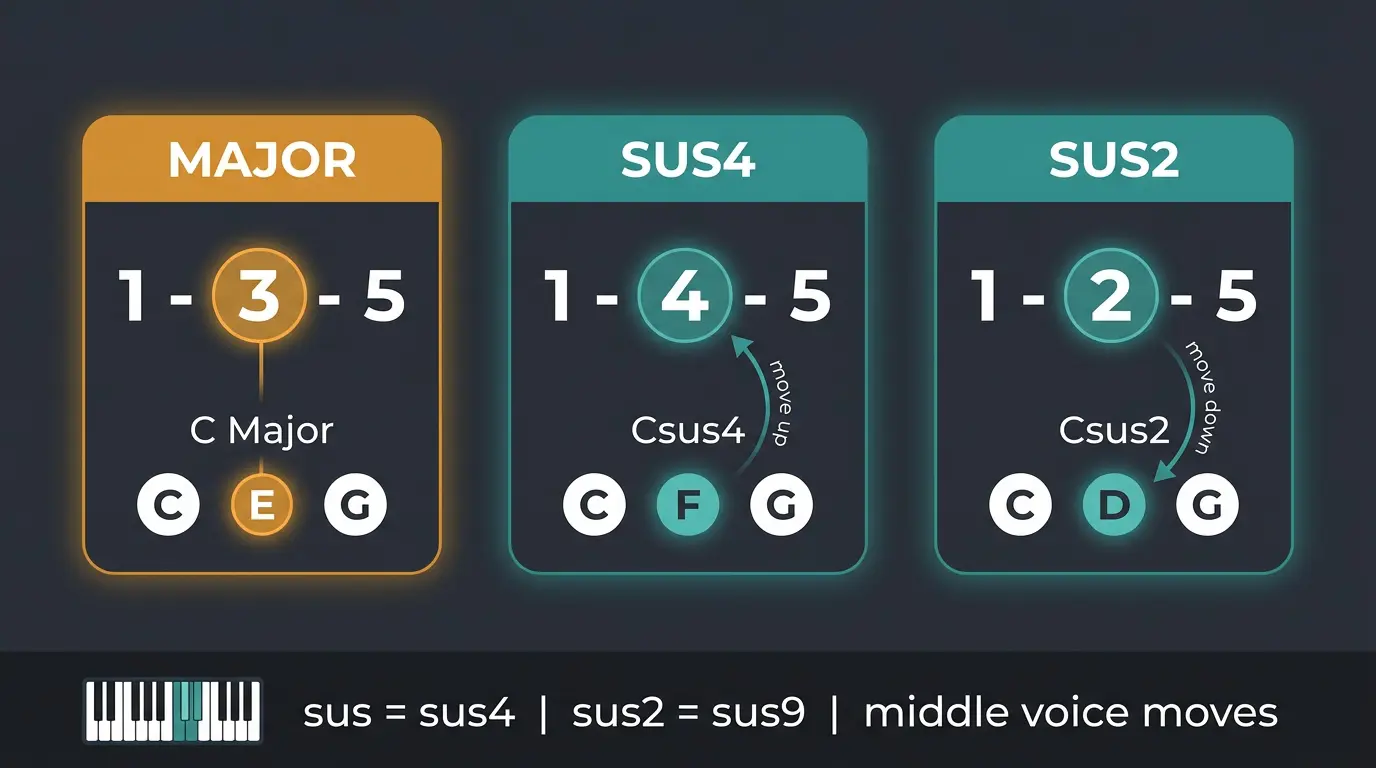
The formulas are simple once you see them side by side. A normal major triad is 1-3-5. Sus chords just move that middle number.
- Sus4 is 1-4-5 — replace the third with the perfect fourth.
- Sus2 is 1-2-5 — replace the third with the major second.
Some worked examples. C major is C-E-G. Swap the E for an F and you get Csus4 (C-F-G). Swap the E for a D instead and you get Csus2 (C-D-G).
Same deal in D. Dsus4 is D-G-A, and Dsus2 is D-E-A. Once you know the shape, you can build it anywhere.
A quick note on how these get written. Sus4 sometimes shows up as just "sus" with no number — that's shorthand for sus4. And sus2 occasionally gets labeled "sus9," which means the same thing.
On guitar, this is usually a one-finger change from a chord you already know. On piano, hold the triad and just move the middle voice — slide it down for sus2 or up for sus4. If you're working these out at the keys, our guide on writing a song on piano pairs well with this.
The sus2 and sus4 relationship: same notes, different name
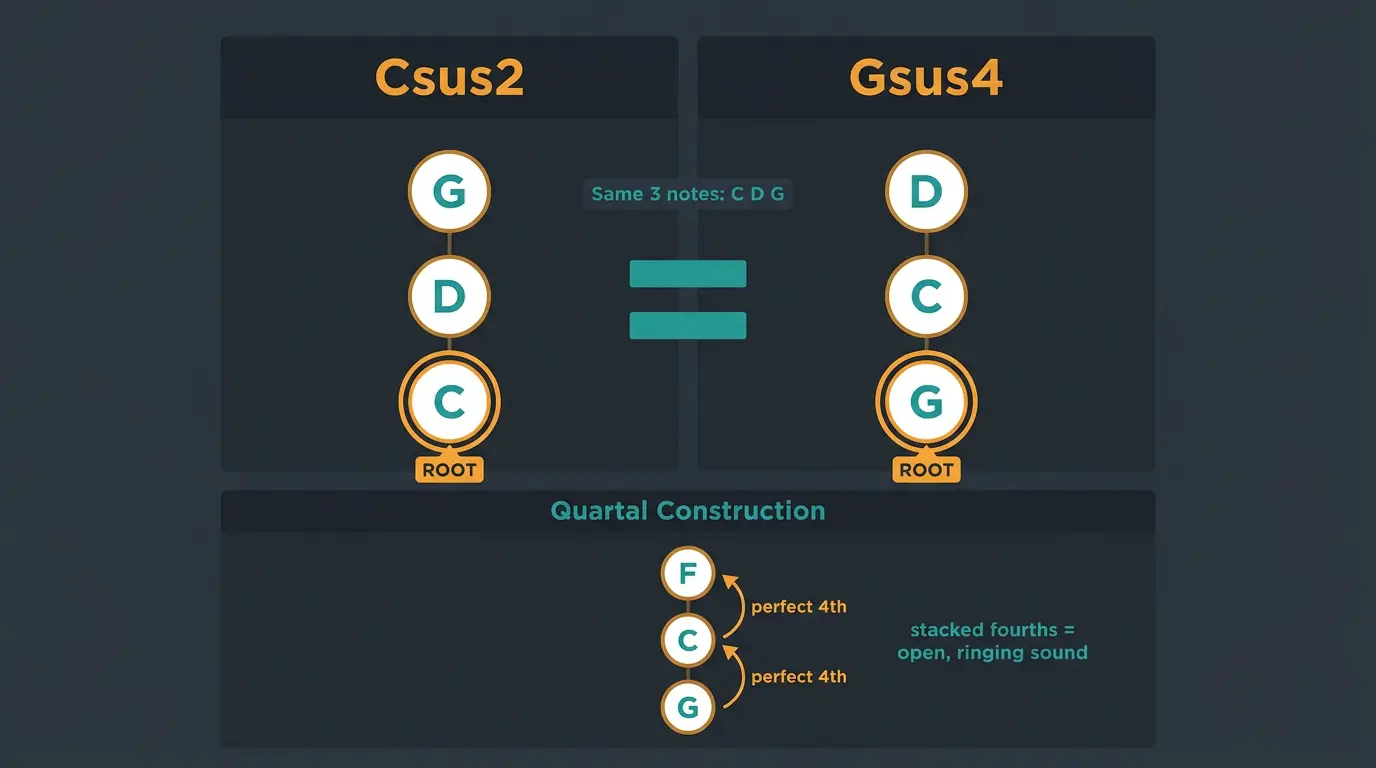
Here's something that ties right back to inversions. A sus2 and the sus4 built a perfect fifth above it are the exact same three notes.
Csus2 is C-D-G. Gsus4 is G-C-D. Same three pitches. The only difference is which note you're calling the root. Learn one shape and you've quietly learned two chords.
The reason this works comes down to how the chord is built. Rearrange C-D-G and you get stacked fourths — G up to C, C up to F, that kind of thing. That's called quartal construction, and it's why sus chords ring so open. Modern jazz leaned hard on that sound, and once your ear catches it, you'll hear it everywhere.
Why suspended chords feel unresolved
Two things are going on. There's no third to give the chord a stable identity, and there's a bit of dissonance baked into the intervals. Together, that leaves the chord feeling like it's holding its breath.
But sus2 and sus4 don't feel the same. A sus4 leans forward. There's tension in it, and it sounds like it wants to move somewhere.
A sus2 floats. It's the more stable of the two — spacious and airy, and it can often just sit there on its own without begging to resolve. Play both and you'll hear the difference right away. Trust your ears on this one.
How suspended chords resolve
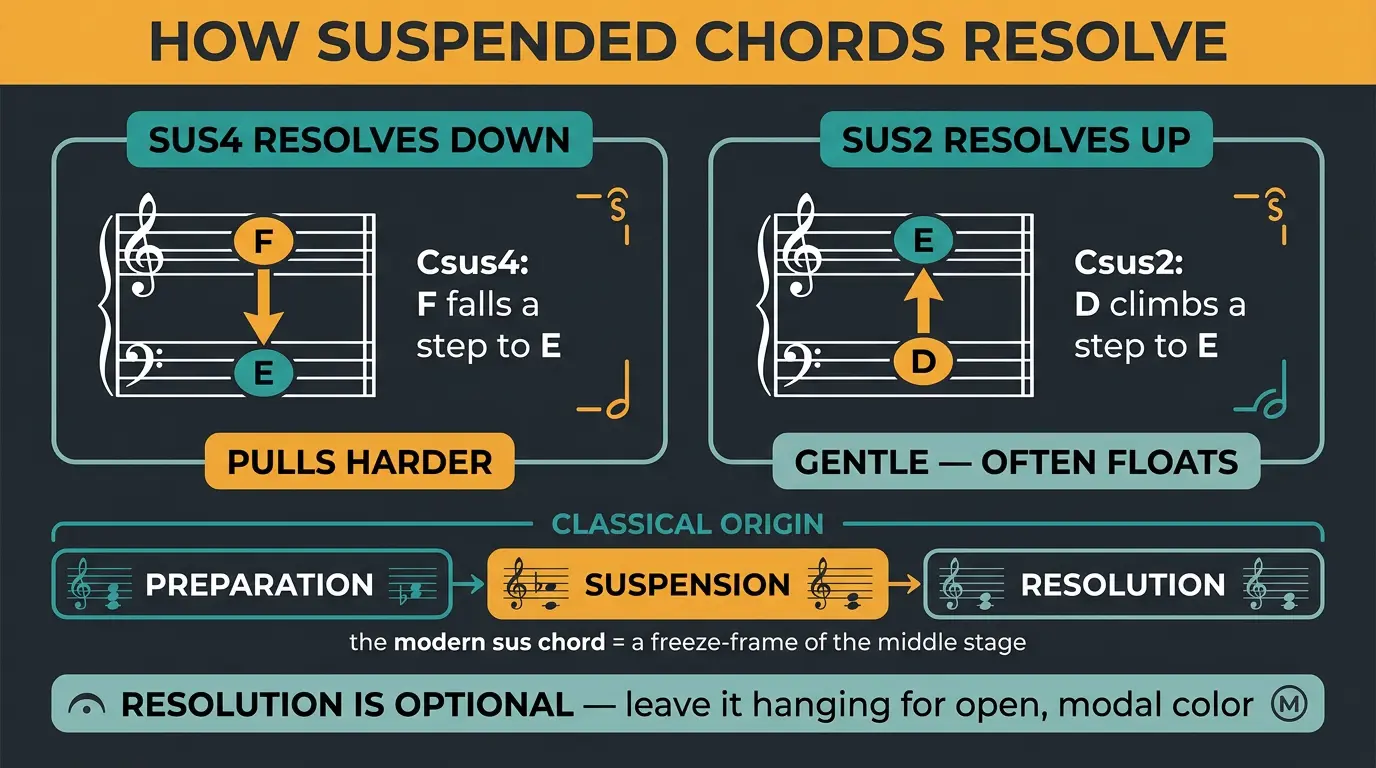
When a sus chord does resolve, it's really just a voice-leading event — one note steps over to the third. And the two types move in opposite directions.
- Sus4 resolves down. The fourth falls a step to the third. In C, the F of Csus4 drops to E.
- Sus2 resolves up. The second rises a step to the third. In C, the D of Csus2 climbs to E.
The sus4 pulls harder. A falling fourth sounds like tension letting go, so your ear really wants it to land. The sus2 is gentler and often just floats instead.
The name comes from classical counterpoint, where a note from one chord gets "suspended" over into the next and then resolves. That original suspension had three stages: preparation, suspension, and resolution. The modern sus chord is basically a freeze-frame of that middle moment, named and turned into its own thing.
Here's the key nuance for anyone writing today: resolution is optional. Pop and modern music kept the sus chord and threw out the rule that it has to resolve. Leave it hanging and it stops being a suspension and becomes a static color — open, modal, a little dreamy. That's a feature, not a mistake.
Common ways to use sus chords
The most common trick is the push-pull. Take a static chord and decorate it: Csus4 - C - Csus2 - C. You're not changing the harmony, you're adding rhythmic tension and release. It fills out a plain chord with motion and keeps a section from sitting still.
Then there's the 7sus4, sometimes written G7sus4 or G11. You build it by adding a minor seventh on top of the sus4 structure. It works as a dominant chord that delays the resolution to the tonic even longer than a plain V7 would. Gospel, soul, and funk are built on this sound.
Jazz players often think of a sus as a ii chord sitting over a V root — something like G-7 over C. That framing connects straight to modal jazz, where sus chords are everywhere. McCoy Tyner used them constantly, and Herbie Hancock described the main chord of "Maiden Voyage" as a seventh chord with a suspended fourth on the bottom. If you want to go further down that road, our intro to jazz chord progressions is a good next stop.
Sus chords at a glance
- Sus4 is 1-4-5 and leans forward — it feels like it wants to resolve.
- Sus2 is 1-2-5 and floats — more stable, often able to stand on its own.
- Both keep the root and fifth and drop the third, which is why they don't sound major or minor.
- A sus2 and the sus4 a fifth above it are the same three notes, and in modern music resolution is completely optional.
| Feature | Sus2 | Sus4 |
|---|---|---|
| Formula | 1-2-5 | 1-4-5 |
| Replaced note | Third swapped for major second | Third swapped for perfect fourth |
| C example | C-D-G | C-F-G |
| Feel | Floats, more stable | Leans forward, more tense |
| Typical resolution | 2nd rises to 3rd (D to E) | 4th falls to 3rd (F to E) |
Frequently Asked Questions (FAQs)
What is a suspended chord?
A suspended chord is a triad with the third replaced by either a major second (sus2) or a perfect fourth (sus4). It keeps the root and fifth but drops the third, so it doesn't sound major or minor — it sounds open and undecided instead.
What's the difference between sus2 and sus4?
A sus2 replaces the third with a major second (formula 1-2-5) and tends to float. A sus4 replaces the third with a perfect fourth (formula 1-4-5) and leans forward, sounding more tense. In C, that's C-D-G versus C-F-G.
Are sus chords major or minor?
Neither. Sus chords have no third, and the third is the note that makes a chord major or minor. Without it, there's nothing telling your ear happy or sad, which is exactly why suspended chords sound so open and ambiguous.
Do suspended chords have to resolve?
No. In classical counterpoint a suspension resolves by stepping to the third, but modern pop and rock keep sus chords hanging on purpose. Left unresolved, a sus becomes a static, open, modal color rather than a tension that has to release.
What is a 7sus4 chord?
A 7sus4 is a sus4 chord with a minor seventh added on top, often written as G7sus4 or G11. It works as a dominant chord that delays resolving to the tonic, and it's a staple sound in gospel, soul, and funk.
Final Thoughts
Sus chords are one of the best returns on a small amount of effort in all of harmony. One note moves, and a plain triad turns into something open, tense, or dreamy depending on where you leave it. Less is more, and this is a perfect example of that.
Make sure you actually play these rather than just reading about them. Build a Csus4, resolve it, then leave one hanging and sit in that sound. If you want to keep going, the Wikipedia entry on suspended chords has more on the classical roots. Your ears will tell you the rest.
Some of the links within this article are affiliate links. These links are from various companies such as Amazon. This means if you click on any of these links and purchase the item or service, I will receive an affiliate commission. This is at no cost to you and the money gets invested back into Audio Sorcerer LLC.