A motif is a short musical idea — longer than a single note but shorter than a full phrase — that carries thematic weight and keeps coming back through a piece. It's the smallest chunk of music that still has an identity of its own.
Here's an analogy that sticks. If a note is a letter, then a motif is a word, and a phrase is a full sentence. A phrase feels complete on its own; a motif is a fragment you can build with. And if you've read our post on hooks, this'll feel familiar — melodic motifs are some of the core building blocks a melody is made from.
TABLE OF CONTENTS
What a motif actually is
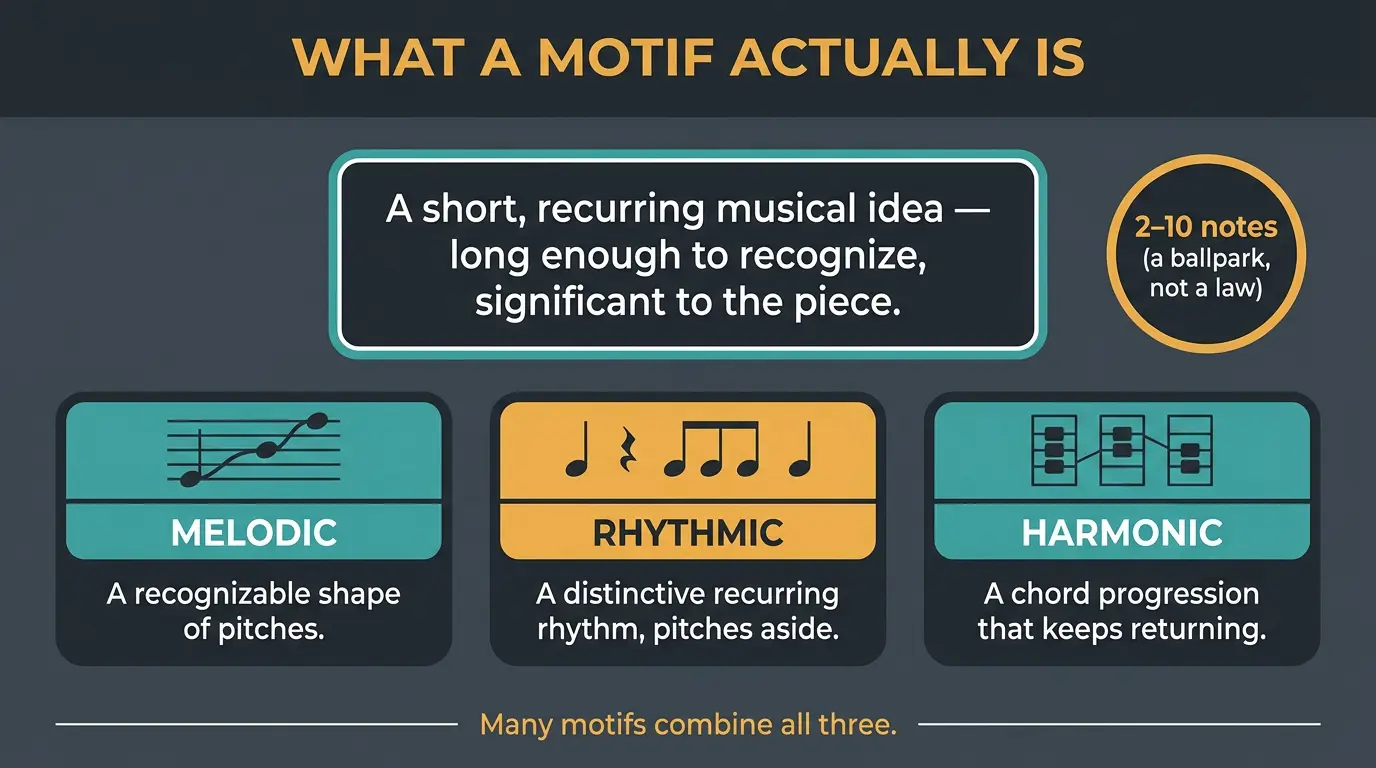
Plainly put, a motif is a short, recurring musical idea that matters to the piece it lives in. A rough guideline people like is somewhere between 2 and 10 notes — but treat that as a ballpark, not a law. The real test is simpler: it has to be long enough to recognize, and it has to carry some significance.
One thing worth clearing up early: motifs aren't only melodic. They come in three flavors.
- Melodic — a recognizable shape of pitches. This is the direct link to melody writing.
- Rhythmic — a distinctive rhythm that recurs, pitches aside.
- Harmonic — a chord movement or progression that keeps returning.
Plenty of motifs combine all three. But don't assume a motif has to be a tune — a rhythm alone can do the job.
How a motif gets developed
Here's the part that trips people up. A motif isn't just copied and pasted over and over. It's developed. The whole art is varying it while keeping its identity recognizable.
That's where the magic happens — and it's not mystical magic, it's just craft. Development is what gives a piece unity (the same idea threads through everything) while keeping it interesting (the idea never shows up exactly the same way twice). The techniques below are the toolkit for pulling that off.
Repetition and sequence
Repetition is the simplest one — you state the motif again in its original form. That's not lazy; it's how a motif becomes familiar in the first place. Listeners need to hear an idea a few times before it feels like a landmark.
Sequence is repetition with a twist: you restate the motif at successive pitch levels, each one a scale degree higher or lower. Two or three times in a row, climbing or descending.
Quick clarification that matters. Transposition and sequence get mixed up. Transposition moves the motif to a new pitch level once, keeping every interval intact. A sequence repeats it at new levels, back to back. If you want to go deeper on moving ideas around, we've got a whole post on transposing a song into a different key.
Inversion, augmentation, and diminution
Inversion flips the direction of the intervals. If the original leaps up a third, the inversion leaps down a third. The contour gets mirrored, like a reflection in water, but the DNA of the idea is still there.
Augmentation lengthens the note values — you keep every pitch exactly where it was and stretch the rhythm, often doubling each duration. The effect tends to feel broad and majestic.
Diminution is the opposite: shorten the durations, often by half, pitches untouched. That makes the same idea feel urgent and busy. Same notes, totally different energy. Don't overthink which to use — try both and trust your ears.
Fragmentation and retrograde
Fragmentation means breaking off just a piece of the motif — usually the opening notes — and developing that smaller chunk on its own. Because a fragment is more compressed than the whole thing, it's a favorite trick for building momentum right before a cadence.
Retrograde is exactly what it sounds like: play the motif backward. It's less common in pop and rock, but it's a real tool, and it's fun to experiment with even if only a theory nerd will ever catch it.
What changes vs. what stays
- Transposition — the starting pitch changes, but every interval between the notes stays the same.
- Augmentation — the rhythm lengthens, while every pitch stays exactly where it was.
- Diminution — the rhythm shortens, while every pitch stays exactly where it was.
- Sequence — the motif is repeated at new pitch levels, but its internal shape stays intact.
- Fragmentation — only part of the motif survives, and the pitches and rhythm of that fragment stay put.
- Change of mode — a note or two changes, often the third, while the rhythm and contour stay the same.
Motif examples you already know

You've got motifs in your head right now whether you know the word or not. Let's give it a listen to a few.
The go-to example is the opening of Beethoven's Fifth — three short notes and one long one, often called the "fate motif." Four notes. That's it. Beethoven repeats and varies that tiny idea across the whole first movement and beyond, and it still sounds inevitable every time.
Film scores are where motifs really get room to breathe. A leitmotif is a motif tied to a single point of reference — usually a character — that plays whenever they show up. John Williams nailed it with Jaws: three notes, functioning as an ostinato (a motif that repeats), where the pace speeds up to crank the tension. The Monty Norman James Bond theme does the opposite dance with its four-note motif — vibrant and cocky when Bond's in control, subdued and tense when he's not.
And rock is full of them. Deep Purple's "Smoke on the Water" is maybe the most recognizable guitar motif ever written. Four notes, and every beginner guitarist on earth has fumbled through it. If you want to go down the rabbit hole, the overview of motif is a solid starting point.
Motif vs. hook vs. riff
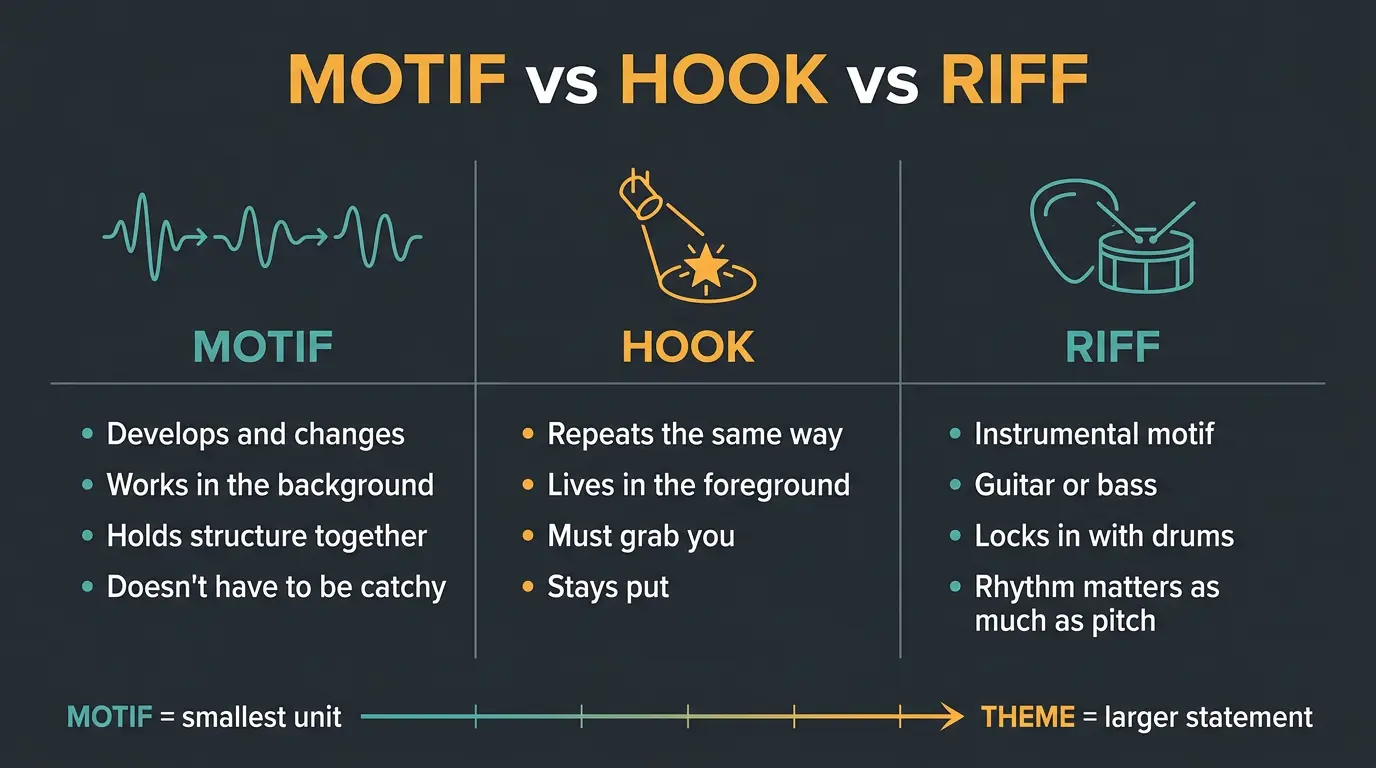
These three terms get tangled constantly, so let's untangle them.
A hook repeats pretty much the same way every time, and it lives in the foreground — it's the part you can't not notice. A motif develops and changes, and it tends to work in the background, holding the structure together. That's why we say "motivic development" but basically never say "hook development." Hooks stay put; motifs are malleable. And they can absolutely live in the same song at the same time.
A riff is usually an instrumental motif — guitar or bass — that locks in with the drums to drive a groove. Its rhythm matters as much as its pitches. A theme is bigger and more fully composed than a motif; think of a motif as the smallest unit and a theme as a larger statement built partly from it.
One last thing: a motif doesn't have to be catchy to do its job. A hook has to grab you. A motif just has to show up, in its various disguises, and quietly tie the whole thing together.
Using a motif in your own songwriting
Here's the practical payoff. Just like a hook can be the seed a whole song grows from, a motif can be that seed too. You take one short, identifiable idea and let it show up across sections — verse, chorus, bridge — so the song feels like one connected piece instead of a bunch of parts stapled together.
The trick is variation. Reuse the same idea for unity, then lean on the development techniques above so it never gets monotonous. Augment it for the chorus. Fragment it into the bridge. Flip it upside down for the second verse. Same DNA, different clothes.
Less is more here. You don't need a new idea for every section — you need one good idea you're willing to keep reshaping. Make sure you experiment and trust your ears. There isn't a right or wrong way to develop a motif, just the version that feels right for the song.
Frequently Asked Questions (FAQs)
What is a motif in music?
A motif is a short, recurring musical idea — longer than a single note but shorter than a full phrase — that carries thematic significance in a piece. It's the smallest musical unit that still has a recognizable identity, and it can be melodic, rhythmic, or harmonic.
How long is a motif?
A motif is usually somewhere between 2 and 10 notes, though that's a rough guideline rather than a hard rule. What actually matters is that it's long enough to be recognizable and short enough to repeat and develop easily throughout a piece.
What's the difference between a motif and a theme?
A motif is the smallest building block — a short idea of just a few notes — while a theme is larger and more fully composed. Think of a motif as a word and a theme as a full sentence that may be built partly from that motif.
Is a motif the same as a hook?
No. A hook repeats the same way every time and lives in the foreground to grab attention, while a motif develops and changes and usually works in the background to hold the structure together. A single song can use both at once.
What is a leitmotif?
A leitmotif is a specific kind of motif tied to a single point of reference, usually a character in a film or opera, played whenever that reference appears. The Jaws shark theme and the James Bond theme are two famous examples you'd recognize instantly.
Final Thoughts
A motif is one of those ideas that changes how you hear everything once it clicks. Once you start noticing them, you'll hear the same little fragment getting stretched, flipped, and chopped up all over your favorite songs — and you'll realize how much mileage a good composer gets out of one tiny idea.
So grab a short phrase you like and start messing with it. Augment it, invert it, break off the first three notes and see where they take you. Trust your ears, and let one small idea do a lot of work.
Some of the links within this article are affiliate links. These links are from various companies such as Amazon. This means if you click on any of these links and purchase the item or service, I will receive an affiliate commission. This is at no cost to you and the money gets invested back into Audio Sorcerer LLC.