A hook is the most concise, memorable, repeatable part of a song — the bit that catches your ear and pulls you back in. It's the part you're humming hours later without even meaning to.
The name comes from fishing, of all places. The hook is what reels the listener in. In this post I'll cover what a hook actually is, the main types, real examples you already know by heart, and how to write one of your own.
TABLE OF CONTENTS
What a hook actually is
A hook is a short musical or lyrical phrase that stands out and sticks in your memory. In songwriting terms, it's the thing you're selling — the moment a casual listener decides they like the song.
A hook can be melodic, lyrical, rhythmic, or built from a unique production sound. Some of the best songs combine a few of those at once.
Here's the misconception worth clearing up: the hook is not always the chorus. Sometimes it lives in the chorus, sure. But it can show up in the intro, the pre-chorus, a verse, or a post-chorus vocal chop. One song can have several hooks layered through it. If you want a refresher on where those parts sit, check out our breakdown of verse, chorus, bridge and the rest of song structure.
The short version
- A hook is the stickiest, most repeatable part of a song — the part that gets stuck in your head.
- Hooks can be melodic, lyrical, rhythmic, or production-based.
- A hook doesn't have to be the chorus — it can live anywhere in the song.
- Most hit songs combine at least two types of hook.
The main types of hooks
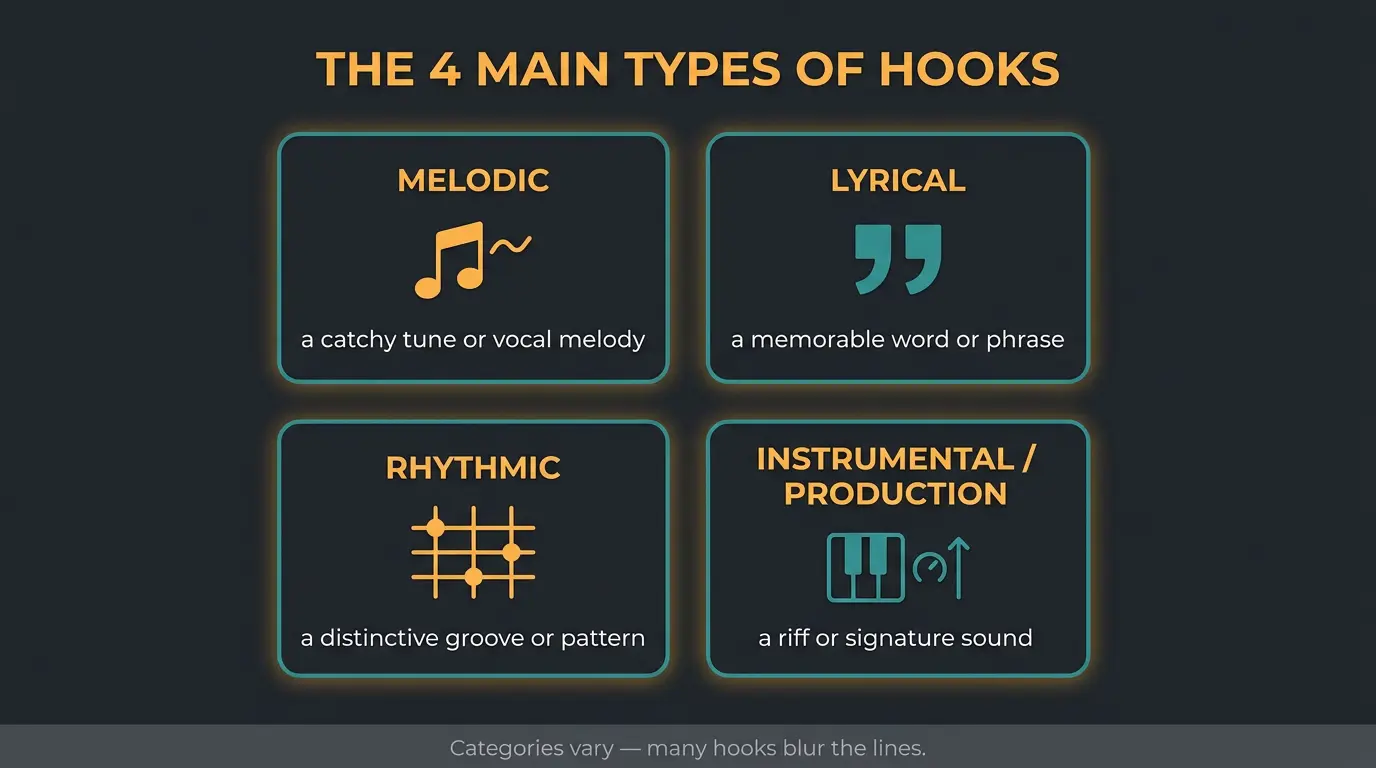
Most sources land on four main categories: melodic, lyrical, rhythmic, and instrumental or production hooks. Taxonomies vary depending on who you ask, so don't treat this as gospel — plenty of hooks blur the lines.
With that being said, these four buckets cover just about everything you'll run into. Let's go through them one at a time.
Melodic hooks
A melodic hook is a short, memorable musical phrase built on notes and phrasing rather than words. It's the line you'd hum if someone asked you how the song goes.
The riff in "Smoke on the Water." The synth in Avicii's "Levels." The piano in "Still D.R.E." The guitar in "Seven Nation Army." None of those need lyrics to be instantly recognizable — that's a melodic hook doing its job.
Lyrical hooks
A lyrical hook is a standout word or phrase, and it's often the song title and the main idea rolled into one. Think "Single Ladies" or "Rolling in the Deep." You hear the line once and it's lodged in there.
Lyrical hooks really dominate rap — Eminem's "My Name Is" is a great example, where the cadence makes the line stick as much as the words do. And non-word vocalizations count too. The "yeah, yeah, yeah" in "She Loves You" and the "ah, ah, ah, ah" in "Stayin' Alive" are pure lyrical hooks with barely a word between them. If you want to sharpen the words themselves, here's our guide on writing lyrics that actually connect.
Rhythmic hooks
A rhythmic hook is a pattern that makes people nod or move before they even register the melody or the words. Here's the quick test: if you can tap it out on a table and someone recognizes the song, it's a rhythmic hook.
"We Will Rock You" is the classic — stomp, stomp, clap. The syncopated, whispery groove in Billie Eilish's "Bad Guy" does the same thing. One thing worth noting: rhythmic hooks aren't only about drums. The rhythm of a vocal phrase or a melody line can be the hook just as much as a beat can.
Production hooks
A production hook is a sound that belongs only to your track — a sonic fingerprint. The "Billie Jean" bassline is a perfect one. So is the Theremin in "Good Vibrations."
In modern production, this might be a pitch-shifted vocal chop or a filtered synth stab that nobody else has. Plugins and samplers make this stuff totally accessible in the box now — you don't need a rack of vintage gear to build a signature sound. And here's the bigger point: most hits combine two or more of these hook types. A great melody delivered with a distinct rhythm beats either one on its own.
How to write a hook that sticks
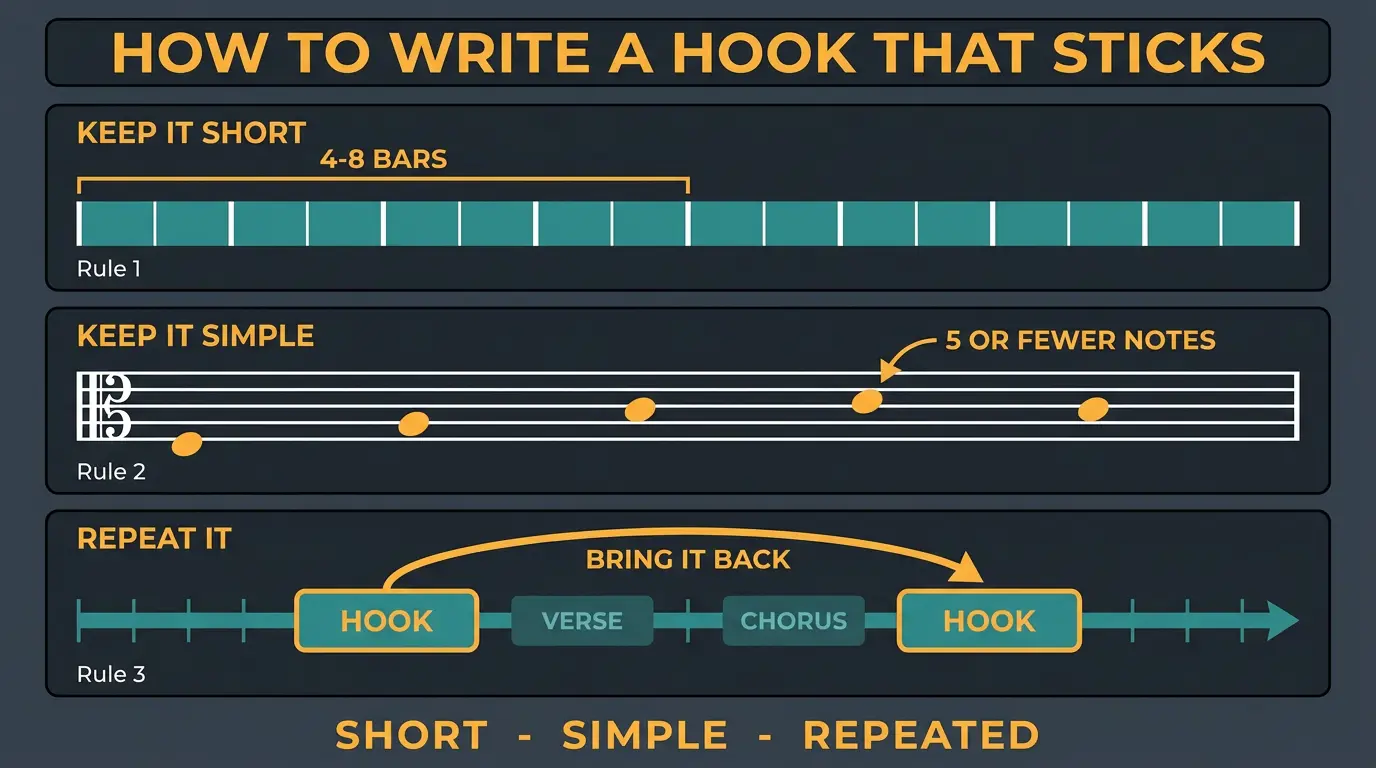
The practical takeaway first: keep it short, keep it simple, and repeat it. That's most of the battle.
Most hooks last four to eight bars and come back across the arrangement. On the melody side, less is more — the most memorable hooks tend to use five or fewer distinct notes, and plenty of pop hooks only use three or four. Long, complicated phrases are hard to remember, which defeats the whole point.
Repetition is what makes a hook a hook. Make sure it shows up at least once more after you introduce it. And if you're writing a title hook, aim for a line that says more than its literal words — "I Will Always Love You" carries a whole emotional world in five syllables.
A simple, strong melody often comes from understanding how notes pull toward each other, so it's worth getting comfortable with scale degrees and how they shape a melody. Beyond that, trust your ears. There's no single right place to put a hook — try it in the intro, try it as a post-chorus, see what grabs you. For more background, the Wikipedia entry on hooks in music is a solid read.
Frequently Asked Questions (FAQs)
Is the hook the same as the chorus?
No. The hook is the catchiest, most repeatable fragment of a song, while the chorus is a structural section. The hook often lives inside the chorus, but it can also be an intro riff, a pre-chorus line, or a vocal chop. They overlap a lot, but they're not the same thing.
Can a song have more than one hook?
Yes, a song can absolutely have several hooks. A track might use an intro riff, a vocal hook in the chorus, and a production hook all at once. The strongest songs usually have one dominant hook anchoring the others, but layering them is common and works well.
What's the difference between a hook and a riff?
A riff is a repeated musical figure, while a hook is whatever catches the listener's ear and makes the song memorable. A riff can be the hook — "Seven Nation Army" is both. But a hook can also be a lyric, a rhythm, or a sound, not just a repeated instrumental phrase.
How long should a hook be?
Most hooks last four to eight bars. The key is that it's short enough to remember and repeat across the whole song. Less is more here — a tight, simple phrase sticks far better than a long, complicated one. When in doubt, trim it down.
Does a hook have to have lyrics?
No, a hook doesn't need lyrics at all. Melodic hooks like the "Smoke on the Water" riff, rhythmic hooks like the "We Will Rock You" stomp, and production hooks like the "Billie Jean" bassline all work without a single word. Vocalizations like "yeah, yeah, yeah" count too.
Final Thoughts
A hook isn't magic — it's craft. It's a short, memorable idea that you trust enough to repeat. Once you start listening for them, you'll hear hooks everywhere, and you'll spot which type is doing the work.
So go write some. Keep them simple, let them repeat, and trust your ears over any rulebook. Sometimes the catchiest part of a song is the one you almost talked yourself out of keeping.
Some of the links within this article are affiliate links. These links are from various companies such as Amazon. This means if you click on any of these links and purchase the item or service, I will receive an affiliate commission. This is at no cost to you and the money gets invested back into Audio Sorcerer LLC.